
Democratic governors are pitching themselves as the anti-Washington alternative for 2028 while using cost-of-living fights and Trump confrontation to build a national brand.
What to Know
- Democratic governors are increasingly treating cost of living as the organizing message for 2026 and a launchpad for 2028.
- The Democratic Governors Association has been actively spotlighting governors as the party’s frontline opposition to Trump-era federal moves.
- Recent presidential cycles show “popular in-state” does not automatically translate into “durable national nominee,” especially under modern media pressure.
- Democrats’ “run against Washington” theory hinges on governors looking more operational and less performative than Congress, even when the policy fights are national.
- Voters are still living inside a cost squeeze narrative that keeps rewarding simple economic accountability messages, not abstract party branding.
Democratic governors are arguing that they should be the leading candidates for the 2028 election, positioning themselves as offering both credibility and the ability to govern effectively. They highlight their executive experience on issues like pandemic response and post-Roe policy, contrasting their hands-on leadership with the role of commentators. Democrats believe Trump-style politics makes Washington look more broken and more theatrical by the month, and they want nominees who can plausibly say they fought the consequences, balanced budgets, handled disasters, and still delivered tangible outcomes.

This is not an abstract conversation happening in a vacuum. It is a pre-2026 positioning war, because the governors who become the party’s most visible antagonists to the Trump administration over the next year will also become the party’s most bankable presidential prospects. The idea that governors offer the best path to victory is less a genuine 2028 theory and more a strategy aimed at the 2026 election cycle.
Governors Are Building a Cost-of-Living Brand for 2026 and Beyond
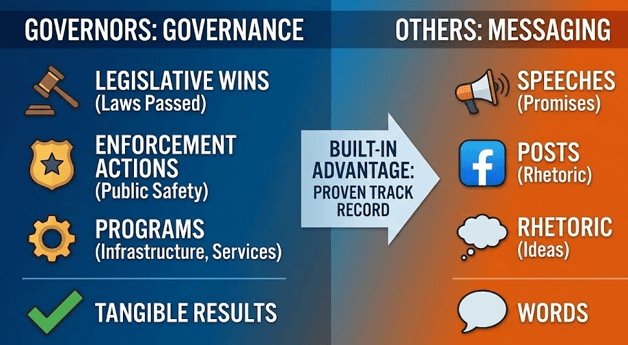
Democratic governors are aligning around a pocketbook-first frame because it is the cleanest political language that travels across state lines. When a governor says they are “fighting high prices,” they are not asking voters to process an ideology. They are asking voters to recognize a lived experience, then credit or blame someone for it. And governors have a built-in advantage here: they can point to programs, enforcement actions, and legislative wins that look like governance rather than messaging.
In the current environment, that governance posture matters because cost-of-living stress is not fading as a political driver. Even modest inflation reopens the same wound for households that feel like their wages never caught up to the last spike. ABC News’ reporting on the Democratic governors’ gathering captured how central affordability has become to their shared playbook, with governors leaning into “lower costs” politics as both policy and campaign content.
Why Governors Think 2028 Could Be Different This Time
Governors believe the presidency now rewards a kind of leadership they have already been forced to practice. Over the past several years, the boundary between state governance and national politics has effectively collapsed. Pandemic-era decisions pushed governors into constant public view, with consequences that were immediate, visible, and relentlessly scrutinized. That environment did not produce universal popularity, but it did produce executives conditioned to govern under national pressure without the buffer of federal bureaucracy.
The post-Roe landscape further shifted political gravity toward the states. Abortion policy became something voters experienced directly, not rhetorically, and governors became the most identifiable actors shaping outcomes. In that role, some Democratic governors strengthened their standing with suburban and college-educated voters who now anchor the party’s coalition, translating state-level authority into durable political trust.
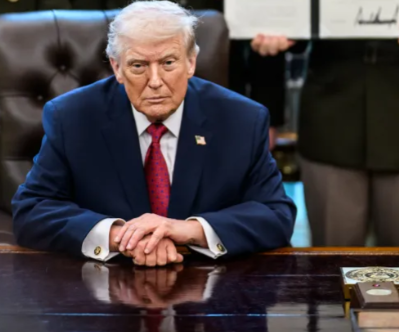
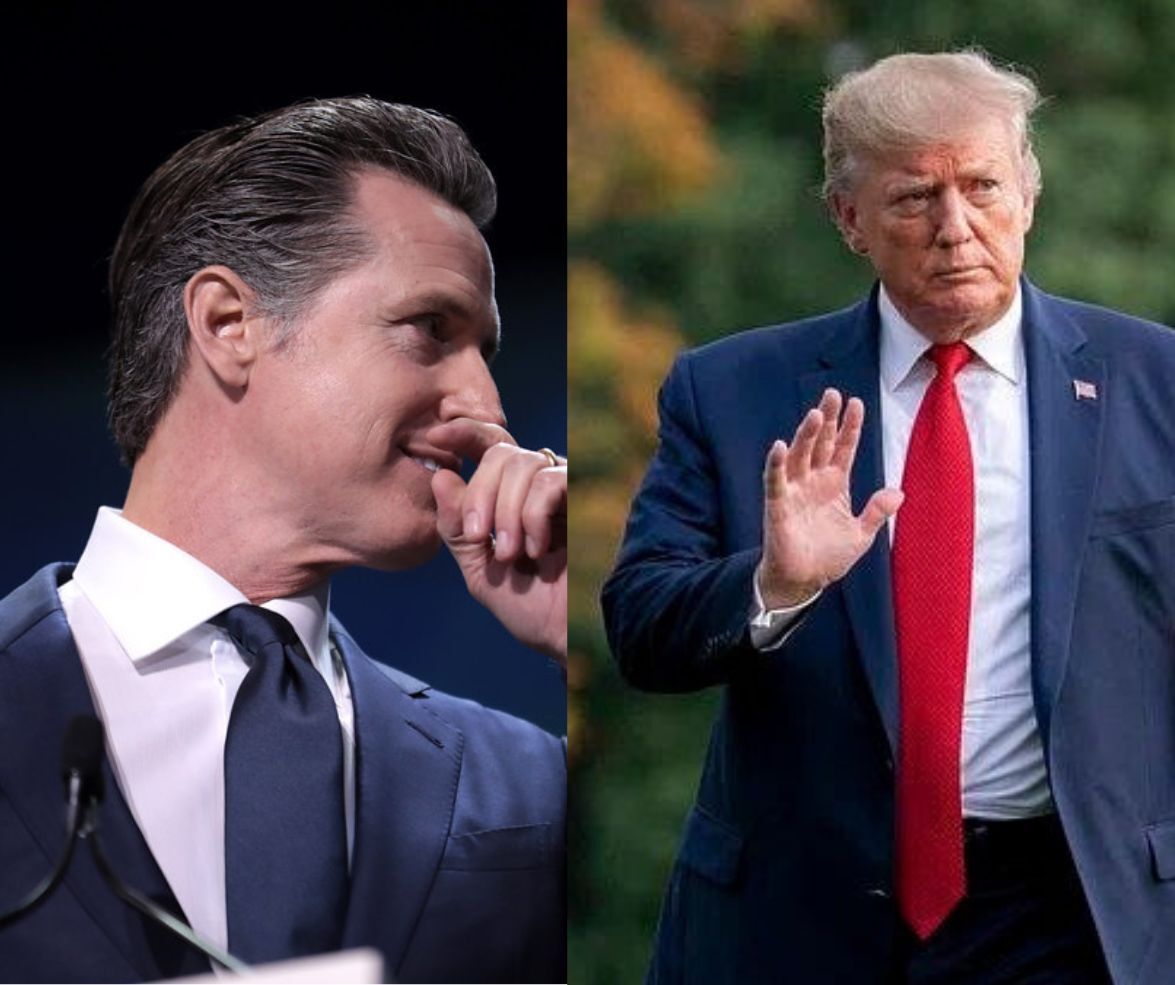
President Donald J. Trump; image via White House
Trump’s return to the center of power has removed any illusion that governors can remain insulated from national conflict. Even reluctant participants are pulled into high-profile disputes, and for those with ambition, that conflict functions as a credibility engine. Visible confrontation now substitutes for traditional résumé-building, accelerating recognition inside a political system that rewards opposition leadership in real time.
In this environment, governors see 2028 not as a long-shot breakthrough but as a structural opening. The job they already do increasingly resembles the one they want, and the pathway to national leadership no longer runs exclusively through Washington.
State Stardom Is Not National Durability
Even if the governors’ logic is coherent, recent political history is a warning label. Candidates who looked invincible in their states have collapsed when exposed to national scrutiny and national opposition research. The difference today is not just campaign mechanics. It is the speed of reputational damage and the way modern media rewards conflict clips over competence. A governor can be a problem-solver in the statehouse and still get nationalized into a caricature by the time voters are paying attention.
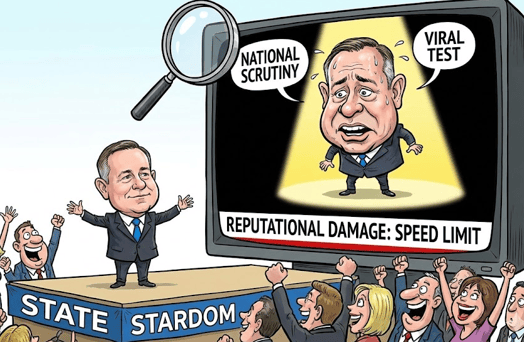
That vulnerability matters for Democrats because their party often demands two things at once: perceived authenticity and perceived readiness. Governors can sell readiness through executive experience, but authenticity is harder once a national campaign turns every speech into a viral test. So the governors’ pitch is not “we are guaranteed to win.” It is “we have a better runway than Washington Democrats who look like part of the problem.”
Pivot Point: Running Against Washington Without Sounding Like You Are Running From It
Here is where the strategy gets operational. “Run against Washington” is easy rhetoric, but hard positioning for Democrats if voters believe Democrats are part of Washington’s culture. Governors want to solve that problem by emphasizing the daily grind of governance. A governor can talk about roads, schools, disasters, budgets, and public safety as real things with measurable outcomes. Congress can talk about those things too, but it usually lands as argument instead of delivery.
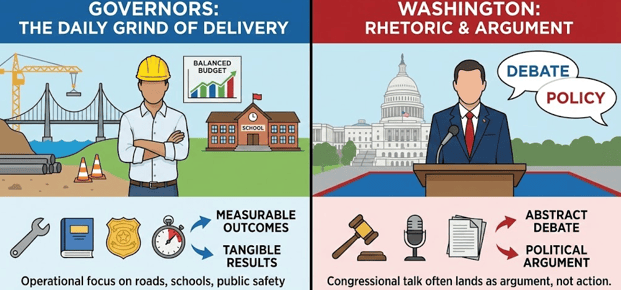
The governors’ claim is that voters are tired of partisan performance, and that executive leadership looks closer to reality. It is the “dirt on our boots” idea: less debate-club energy, more results energy. In campaign terms, that is a brand differentiation strategy aimed at swing voters who are frustrated with both parties but still open to a candidate who feels competent and normal.
The Governors’ Coalition Is a Midterm Machine
The real tell is how governors talk about 2026. They are not only pitching themselves as presidential talent. They are building a multi-state campaign ecosystem that can recruit candidates, raise money, and create message discipline across battleground states. If Democratic governors can nationalize a cost-of-living message while localizing delivery, they can protect vulnerable incumbents and potentially flip competitive governorships and legislative chambers.
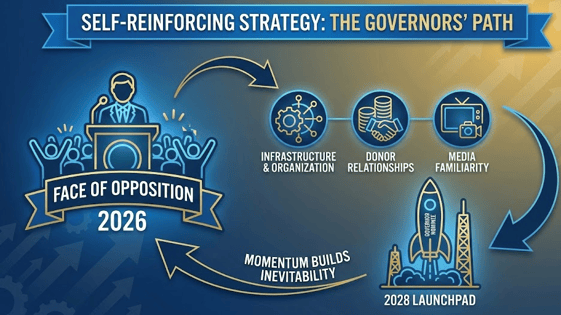
This is also where the party’s internal logic tightens: if governors become the face of the opposition in 2026, the same governors gain the infrastructure, donor relationships, and media familiarity that turn into a 2028 launchpad. That is why the governors’ “best shot” argument is strategically self-reinforcing. The more the party invests in governors as messengers now, the more inevitable a governor nominee can start to feel later.
Global Cost Pressure Is the Story Voters Live In
The governors’ cost-of-living emphasis is also shaped by the global economy, whether campaigns admit it or not. Trade flows, tariffs, and global imbalances show up in consumer prices and job insecurity, which then show up in voter psychology.
|
When a Trade Surplus Becomes a Political Weapon Note the example: China’s trade surplus surpassing $1 trillion is the kind of macroeconomic marker that becomes political ammunition in the U.S., because it can be framed as proof that the economic system is tilted and that domestic workers are paying the price. Reporting this week noted China’s trade surplus passing that threshold for the first time, alongside renewed global concern about imbalances and the knock-on effects for other economies. |
Wrap Up
With voters weary of Washington gridlock, Democratic governors are making a compelling case for 2028: executive experience is a more attractive political brand than legislative history. But their real advantage may be structural, not rhetorical. Governors are building the most scalable “opposition leadership” platform available to Democrats right now because they can fight Trump policies in court, in budgets, and in day-to-day governance, then package those fights into a story of competence under pressure.
For 2026, that matters because midterms are often decided by whether voters feel like they have a credible alternative, not just a complaint. Governors are positioning themselves as the alternative management class. If they can convert cost-of-living anxiety into a disciplined message, and if they can avoid getting trapped in purely national cultural combat, they can shape the battlefield for 2026 and set the terms for 2028. The party’s next nominee might not be inevitable yet, but the governors are clearly building the pipeline, one affordability fight at a time.
-2.png)