

The storied pollster’s departure from presidential approval tracking leaves a void in the data landscape just as the 2026 cycle begins.
What to Know
- Gallup has ended its presidential approval poll after 88 years, a survey that has been a staple of American political analysis since the Franklin D. Roosevelt administration.
- The loss of this continuous data series fragments historical comparisons, as other polling firms use different methodologies.
- Gallup’s polling has often been a "low outlier," so its absence may slightly increase aggregate approval averages.
- The company is shifting its focus from political polling to corporate and employee engagement metrics.
- The loss of a long-term baseline for national mood increases the level of uncertainty in forecasting models for the 2026 elections.
For nearly a century, Gallup’s presidential approval rating functioned as a foundational metric for understanding national sentiment. It offered campaigns, analysts, and media a rare constant in an otherwise shifting data environment.
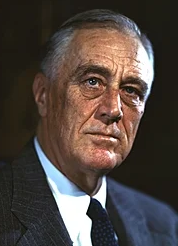
Former President Franklin D. Roosevelt
From Franklin D. Roosevelt to today, Gallup provided a rare constant. Its early 2026 exit creates a structural break; campaigns now lack a long-running benchmark and must rely on a patchwork of inconsistent polling sources.
Fragmentation Replaces Consistency
The immediate consequence of Gallup’s departure is fragmentation. Approval data still exists, but it is no longer standardized across time. Different firms measure approval using varying question wording, survey modes, and turnout assumptions. Some lean online panels. Others rely on mixed-mode or live-caller systems. These differences introduce variance that makes historical comparisons less reliable. Gallup’s strength was not that it was perfect. It was that it was consistent.
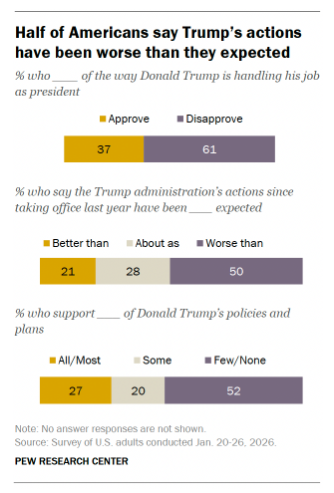
That consistency allowed campaigns to evaluate whether a 2% shift in approval meant something meaningful or simply reflected methodological noise. Without that anchor, distinguishing signal from noise becomes more difficult. For campaign strategy, that translates into risk. Messaging decisions, ad spend allocation, and turnout modeling often rely on small changes in national mood. If those changes are harder to measure cleanly, decision-making becomes less precise.
The “Low Outlier” Effect
Gallup’s polling often registered slightly lower approval ratings than the industry average. That positioning mattered more than most realized. Because Gallup frequently pulled down the aggregate, its inclusion acted as a moderating force on topline averages. With Gallup removed, aggregate approval metrics may drift upward by a small margin.

Campaigns that rely on polling averages to gauge incumbent strength may interpret the environment as marginally more favorable than it actually is. In tight elections, even a perceived shift of 1–2% can influence strategic posture, particularly in battleground states where margins are already narrow. The risk is not that campaigns will be dramatically wrong. It is that they will be slightly off in ways that compound over time.
Why Gallup Walked Away
Gallup’s exit was not abrupt. It reflects a long-term repositioning away from political polling. The firm has steadily shifted toward corporate analytics, focusing on workplace engagement, organizational performance, and proprietary tools like CliftonStrengths. Political polling, once central to its brand, became a smaller share of its business model.
Screenshot of logo from Gallub CliftonStrengths
From a business standpoint, the move is rational. Corporate clients offer recurring revenue and less volatility than election-driven demand cycles. From a political standpoint, the timing is disruptive. The exit comes just as the 2026 midterm cycle begins to take shape, removing a key input at the moment campaigns begin building their modeling frameworks.
The Impact on Forecasting Models
The most significant downstream effect is on forecasting. Presidential approval is a core variable in what analysts refer to as state elasticity models. These models estimate how national political shifts translate into state-level outcomes. If national approval moves by 1%, elasticity modeling attempts to quantify how much each state moves in response.
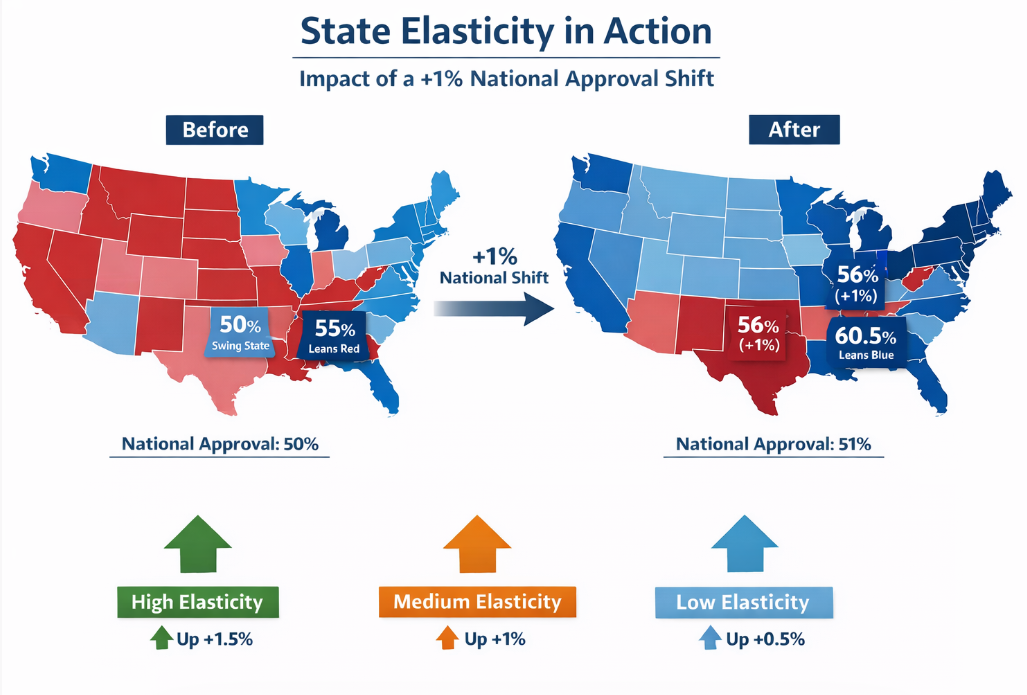
Without a stable national benchmark, that relationship becomes harder to calibrate. More variability in the input produces more variability in the output. Forecast ranges widen. Confidence intervals expand. Campaigns face greater uncertainty when projecting turnout, persuasion targets, and resource allocation.
This does not make forecasting impossible. It makes it less clean. For campaigns operating in a cycle where control of the House and Senate may hinge on a handful of districts or states, reduced precision is not a minor inconvenience. It is a structural disadvantage.
Wrap Up
Gallup’s departure marks a meaningful shift in the foundation of modern political analysis. For nearly a century, its presidential approval tracking served as a consistent reference point that allowed campaigns, analysts, and institutions to measure national sentiment across vastly different political eras. That level of continuity created stability in an otherwise volatile data environment. With that benchmark now removed, the system becomes less anchored and more interpretive.
As the 2026 cycle approaches, campaigns will be forced to operate with a more fragmented set of signals. There is no longer a single, trusted baseline to ground national mood, which means forecasting models must be recalibrated to account for wider variance across polling sources. Assumptions that once held steady over time will need to be reevaluated, and confidence in topline numbers will require more rigorous validation. Small discrepancies between polls, which might have once been dismissed as noise, now carry greater strategic weight.