


A Democratic national polling advantage is changing how both parties define the House battlefield while women and independents remain central to the shift.
What to Know
- Democrats led the July generic ballot by 11 points, with 53% support against 42% for Republicans.
- Women backed Democratic House candidates 56% to 39% in Emerson’s July survey, a 17 point difference between the reported shares.
- Registered independents favored Democrats by 12 points in an early August national survey.
- Only 37 House districts currently sit in Toss Up or Lean categories across the national map.
- Committee target lists now include 46 Democratic offensive districts and 36 Republican offensive districts.
National polling has moved toward Democrats, but the size of that advantage depends heavily on the survey. Emerson College Polling put Democrats ahead 53% to 42% among likely voters in July, compared with 50% to 40% in its April survey. A Reuters and Ipsos survey released on August 3, 2026 found a smaller 42% to 37% Democratic advantage among registered voters, while Economist and YouGov reported 46% to 42% in late July. Taken together, those surveys show a Democratic leaning national environment rather than a uniform double digit lead.
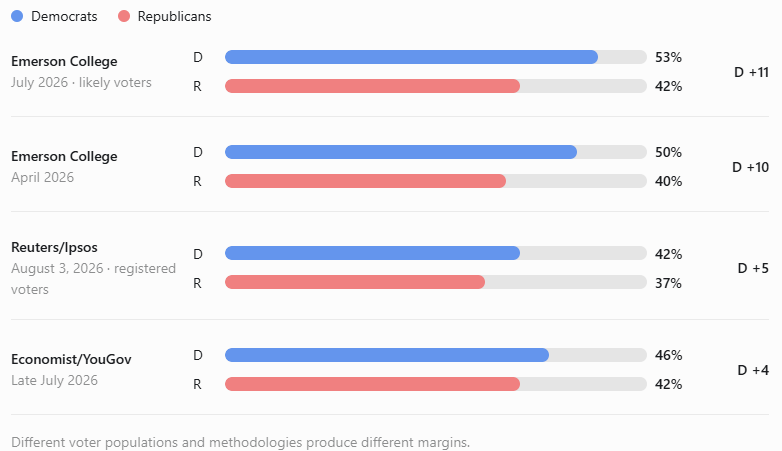
Generic ballot surveys do not decide individual House races because candidates, district boundaries, turnout, and local issues still shape each contest. National conditions nevertheless influence where committees spend money, which challengers receive organizational help, what issues dominate advertising, and how far each party is willing to expand its target list. That distinction is especially important in 2026, when a favorable Democratic polling environment is colliding with a House map made less responsive by another round of redistricting.
Women and Independent Voters Shape the Democratic Advantage
Women remain one of the clearest demographic sources of Democratic strength in the generic ballot. Emerson’s July survey found women supporting Democratic House candidates 56% to 39%. Emerson’s release described that as a 27 point margin, although the reported percentages produce a 17 point difference. Emerson’s April survey had women at 55% to 34%, showing sustained Democratic strength among women across both surveys.
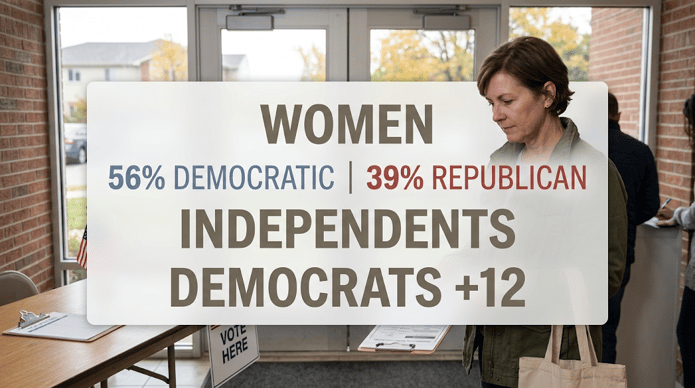
Women and independents widen Democratic opportunities across competitive House districts, Created via Gemini
Suburban women still matter strategically, but the evidence needs a more precise interpretation. Emerson’s national survey does not provide a suburban women subgroup, so it cannot establish that suburban women specifically caused the broader generic ballot movement.
ABC News separately reported research identifying educated, affluent, suburban white women with children as a politically mixed and potentially high turnout swing cohort, making them important persuasion targets rather than a reliably Democratic bloc.
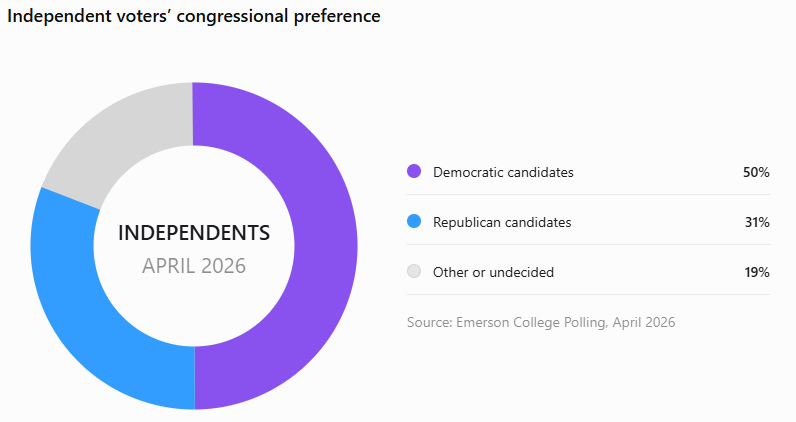
Independent voters provide stronger evidence of movement away from Republicans. Emerson found independents favoring Democrats 50% to 31% in April, while its June survey still showed a 15 point Democratic advantage among independents. Reuters and Ipsos reported in early August that independents favored Democratic congressional candidates by 12 points, suggesting that the Democratic advantage with voters outside the two major parties has persisted across different pollsters and methodologies.
Issue priorities help explain why those voters remain unsettled. Emerson’s July survey found threats to democracy at 28%, the economy at 27%, immigration at 16%, and health care at 13% among likely voters. Reuters and Ipsos also found Democrats narrowly ahead 37% to 36% on which party had the better approach to the economy in early August, giving campaign strategists another reason to treat affordability and economic dissatisfaction as competitive rather than automatically Republican issues.
National Conditions Change Campaign Operations
A favorable national environment matters because campaign committees convert polling signals into decisions about money, recruitment, and organizational support. Current committee activity shows Democrats expanding well beyond a narrow defensive map, but Republicans have not abandoned offensive opportunities of their own. Both parties are therefore using the same national environment to justify broader target lists while prioritizing very different sets of districts.
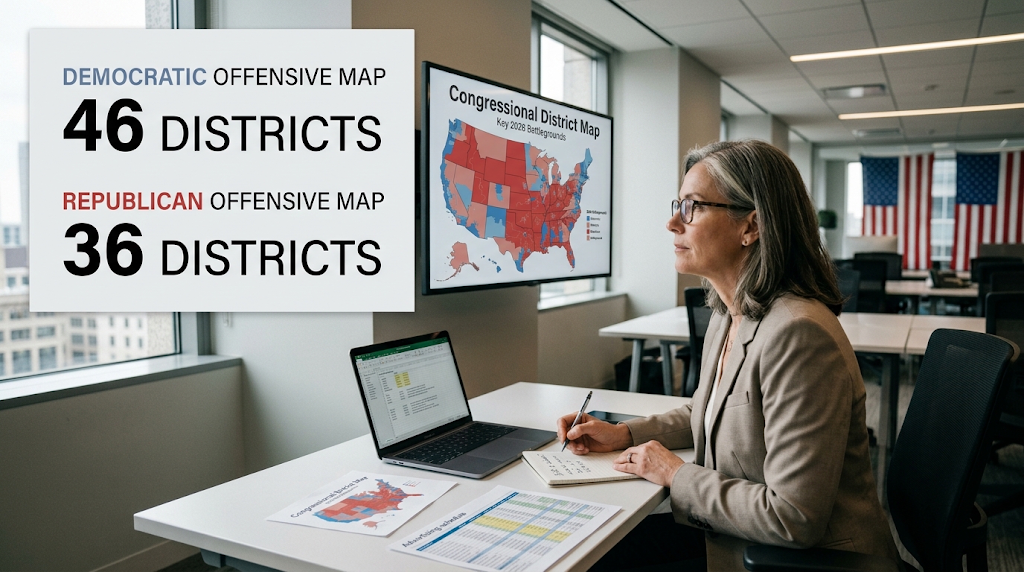
Campaign committees expand targets as national conditions alter resource decisions. Created via Gemini
DCCC currently lists 46 Districts in Play and has built fundraising mechanisms around eventual nominees in many of those seats. Its Red to Blue program provides organizational and fundraising support to selected challengers, turning a favorable political environment into practical candidate investment rather than merely optimistic national messaging.
That structure gives Democrats a way to direct resources toward Republican held districts where candidate quality and local conditions justify additional spending.
NRCC strategy shows why Republicans cannot be treated as moving entirely into defense. Republicans expanded their offensive target list to 36 Democratic held seats on July 20, 2026, while the committee’s MAGA Majority program was supporting 24 candidates with strategic resources and visibility by mid July. Those moves show that a Democratic national polling advantage increases defensive pressure without eliminating Republican efforts to create pickup opportunities.
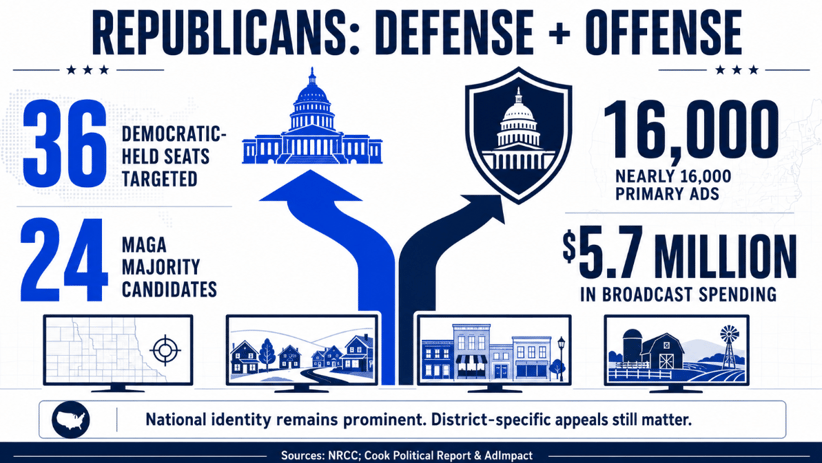
Advertising also looks more complicated than a simple national versus local split. Cook Political Report and AdImpact found that Republican candidates and groups in competitive House districts had aired almost 16,000 primary ads mentioning the president through June 14, 2026, representing about $5.7 million in broadcast spending. That evidence shows national party identity remains prominent in Republican messaging even as individual candidates will increasingly need district specific appeals during the general election.
A Wider Target Map Still Has Structural Limits
Current race ratings show a narrower House battlefield than broad national polling alone might suggest. Cook Political Report currently rates 18 House races as Toss Up, 10 as Lean Democrat, and 9 as Lean Republican, producing a core group of 37 races in the two most competitive rating categories. Reuters has similarly described only about three dozen of the 435 House seats as expected to be truly competitive, reinforcing the distinction between committee target lists and independent race ratings.
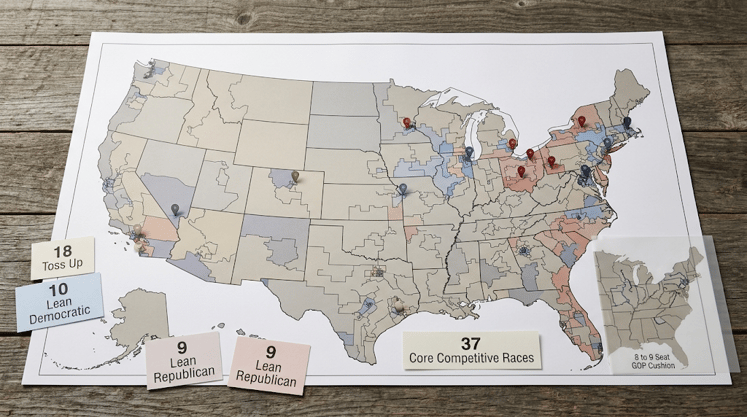
Redistricting limits how national polling advantages translate into House seats, Created via Gemini
Committee target lists are broader because they serve a different strategic purpose. Democrats currently identify 46 offensive districts, while Republicans identify 36 Democratic held targets, and those lists contain seats that independent analysts may not classify as Toss Up or Lean. Current Toss Up races include contests such as Arizona’s 6th, New Jersey’s 7th, New York’s 17th, Pennsylvania’s 7th and 10th, Virginia’s 2nd, and Wisconsin’s 3rd, illustrating how the national environment concentrates attention on a relatively small but geographically diverse set of districts.
|
Strategic measure |
Democrats |
Republicans |
What it means |
|
Committee offensive targets |
46 districts |
36 Democratic-held districts |
Committee lists are broader than independent race ratings and include longer-term pickup opportunities. |
|
Current Toss Up districts |
AZ-06, NJ-07, NY-17, PA-07, PA-10, VA-02, WI-03 |
— |
Competitive races remain concentrated in a small but geographically diverse group of districts. |
|
Redistricting advantage |
— |
8–9-seat cushion |
The current map may prevent a national Democratic vote advantage from translating proportionally into House seats. |
|
Strategic implication |
More fundraising, recruitment, and offensive opportunities |
Greater structural protection despite national pressure |
National polling movement matters, but district boundaries and seat-level competitiveness determine control of the House. |
Redistricting places another limit on how directly a national Democratic vote advantage can translate into seats. Cook estimated in July that Republican gains from the latest redistricting cycle had effectively produced an 8 to 9 seat cushion and later described the resulting House map as more Republican and less electorally elastic. A Democratic generic ballot advantage can therefore expand fundraising and recruitment opportunities without producing a proportional shift in House control, especially when district boundaries reduce the number of seats responsive to national movement.
Suburban oriented districts remain particularly important because they combine high participation, mixed partisan histories, and electorates where candidate quality can still matter. New York’s 17th sits in the Hudson Valley, New Jersey’s 7th covers north central communities including Westfield and Bridgewater, and Virginia’s 2nd includes Virginia Beach and surrounding Tidewater communities.
Each is currently treated as highly competitive, giving both parties a practical reason to pay close attention to women, independents, and other persuadable voters even when national demographic data cannot predict the outcome of a specific district.
Wrap Up
National polling has created a favorable environment for Democrats, but Emerson’s 11 point July result should be understood as one of the stronger Democratic readings rather than the single measure of the national race. Other major surveys still show a Democratic advantage, generally by smaller margins. That consistency is enough to influence campaign planning even without assuming every district will move by the same amount.
Women and independents remain central to the national polling environment, although their electoral effects differ across districts. Women show clear Democratic strength nationally, while suburban women are better understood as a strategically important persuasion group rather than a proven cause of the entire generic ballot shift. Independent movement is more consistently visible across recent surveys and gives Democrats an additional source of support in districts where neither party can rely entirely on its base.
House control will ultimately turn on a much narrower set of races than a national poll can describe. Current committee target lists show both parties expanding their ambitions, while independent ratings and redistricting demonstrate how difficult it remains to convert national sentiment directly into seats. Generic ballot movement matters because it changes where campaigns invest, recruit, advertise, and defend, not because it predetermines what voters will do in every competitive district.

-Aug-01-2026-11-56-55-1279-AM.jpg)