
Meta’s final-week advertising restriction makes verified delivery the decisive test for campaigns seeking uninterrupted election-season reach.
What to Know
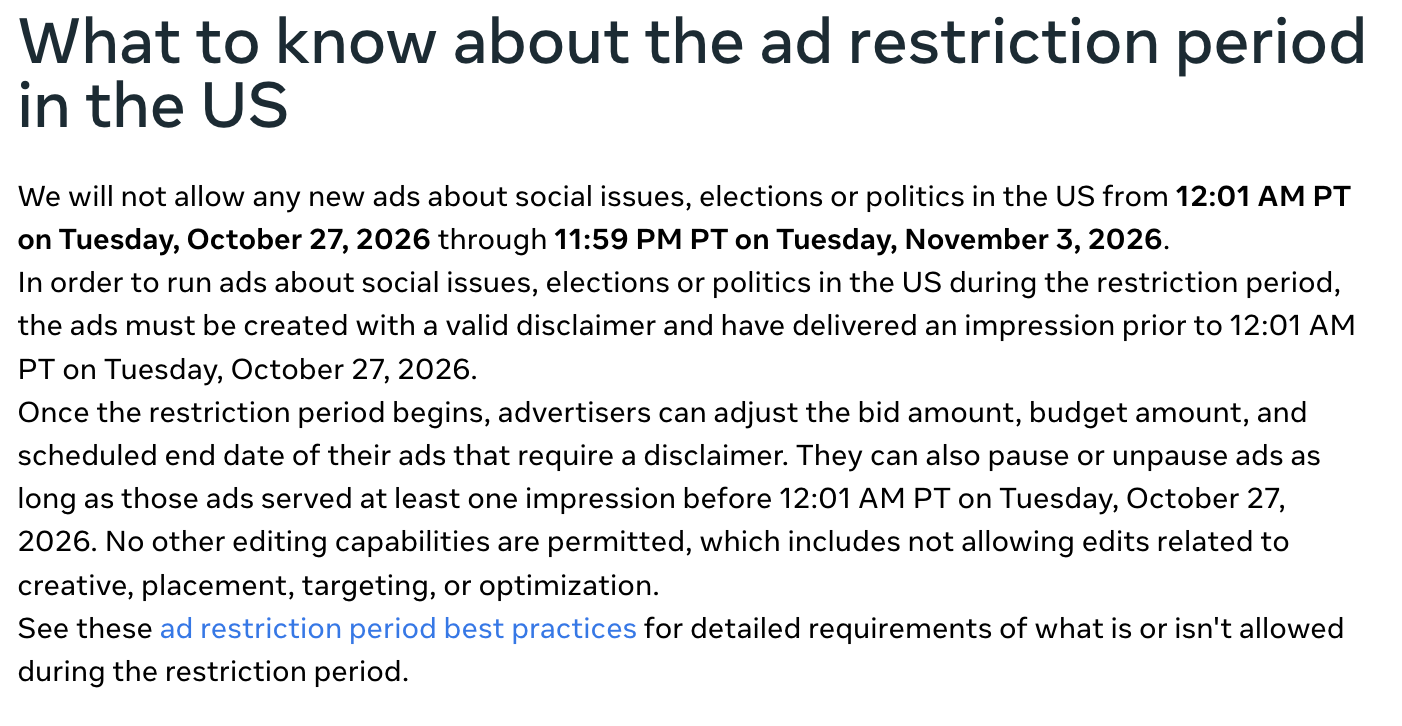
- New qualifying U.S. political ads cannot begin running from 12:01 a.m. PT on October 27 through 11:59 p.m. PT on November 3.
- Each eligible ad must record at least one impression before the restriction begins to continue running during the final week.
- Eligible advertisers may adjust bids, budgets and scheduled end dates or pause and resume existing ads during the restriction.
- Creative, targeting, placements, optimization, campaign objectives and disclaimers cannot be changed once the restriction begins.
- Meta may take 6 to 24 hours to record an impression, making last-minute delivery a significant operational risk.
Meta’s final-week restriction does not create a general shutdown of political advertising. It prevents new U.S. ads about social issues, elections or politics from entering circulation while allowing eligible ads that have already delivered to continue. An official Meta election overview confirms that authorization, a “paid for by” disclaimer and at least one recorded impression remain central to eligibility.

Meta prepares its platforms for the midterm advertising restriction, via Meta.
October guidance adds the exact dates and operating limits campaigns need for execution. Meta’s published restriction begins at 12:01 a.m. PT on October 27, 2026, and ends at 11:59 p.m. PT on November 3, 2026. New ads and broader editing should become available after the restriction expires, but advertisers should verify account status before assuming delivery will restart automatically at 12:00 a.m. PT on November 4.
One Recorded Impression Separates Eligible Ads From New Ads
Approval alone does not secure an ad’s place in the final-week rotation. Meta requires an eligible ad to have recorded at least one impression before the restriction begins. An ad that has been created, submitted or approved but has not recorded an impression does not satisfy that delivery requirement.
Meta’s distinction matters because an impression can take 6 to 24 hours to appear in its systems. An ad that first delivers late on October 26 could therefore remain operationally uncertain when the restriction starts. Advertisers should verify recorded delivery rather than relying on an approved status, an active toggle or an expected launch time.
Edits that return an ad to review create the same risk. Campaigns should confirm that the final reviewed version has recorded an impression before the cutoff instead of assuming an earlier version’s history will protect the revised ad. Meta’s broader election guidance explains the policy rationale: final-week restrictions limit the introduction of new claims when opponents, journalists and voters may have too little time to contest them.

Recorded delivery determines whether an ad survives the cutoff, via Social Media Today.
Scope also requires precision. Placement of the notice within Meta’s government and nonprofit resources does not mean that every advertisement purchased by a government agency or nonprofit is restricted. Coverage depends on whether the advertisement qualifies under Meta’s category for U.S. ads about social issues, elections or politics.
Organizations running a mix of fundraising, public-service, advocacy and election-related advertising should classify each ad separately. A general institutional message may be treated differently from advocacy involving a regulated social issue. Uncertainty should be resolved before launch because the restriction period offers no safe window for testing a disputed classification.
Permitted Controls Preserve Delivery but Not Strategy
Meta leaves advertisers with a narrow set of continuity controls during the restriction. Eligible ads may continue running, and advertisers may adjust bid amounts, budget amounts and scheduled end dates. They may also pause and resume eligible ads.
Those permissions do not create a general right to edit schedules or rebuild campaigns. Meta identifies the scheduled end date, not unrestricted scheduling, as the adjustable field. Changing a start date, replacing an ad or creating a revised version should not be treated as an allowed substitute.
Substantive changes remain prohibited because they could alter the message, audience or delivery strategy after the cutoff. A campaign cannot use the permitted budget controls to transform an existing ad into a materially different communication. Continuity is allowed. Reinvention is not.
Meta’s current transparency system also brings advertiser, payer, beneficiary and “Paid for by” information into its “About this ad” interface, making an accurate disclaimer part of the public record attached to covered campaigns.
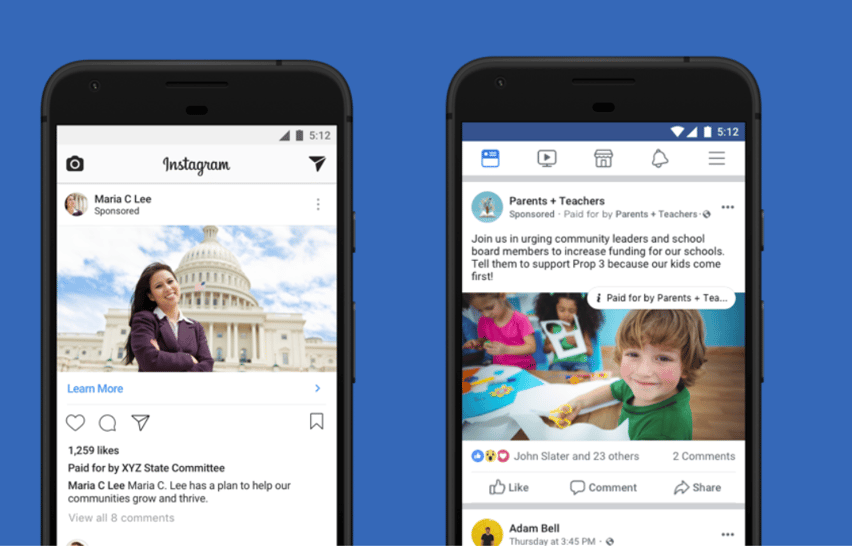
Political ads retain visible payer and disclosure information, via Meta.
|
Control or element |
Status during the restriction |
Operational meaning |
|
Bid amount |
Permitted |
Advertisers may change the bid attached to an eligible ad. |
|
Budget amount |
Permitted |
Advertisers may raise or lower spending without changing the ad itself. |
|
Scheduled end date |
Permitted |
Advertisers may change when an eligible ad ends. |
|
Pause or resume |
Permitted |
Advertisers may stop and restart an otherwise eligible ad. |
|
Creative, copy, images or video |
Prohibited |
New messaging and replacement assets cannot be introduced. |
|
Website URL or call to action |
Prohibited |
Landing destinations and response mechanisms remain fixed. |
|
Targeting |
Prohibited |
Audiences cannot be materially revised during the restriction. |
|
Placements |
Prohibited |
Placement selections and account-level placement controls remain frozen. |
|
Optimization |
Prohibited |
Delivery optimization cannot be changed. |
|
Campaign objective |
Prohibited |
Advertisers cannot redirect the campaign toward a different objective. |
|
Disclaimer |
Prohibited |
Advertisers cannot add, remove or switch the approved disclaimer. |
Account-level controls deserve particular attention. A change that appears administrative may still alter placements or delivery settings across several ads. Agencies and distributed organizations should restrict editing permissions during the period so that one account-wide adjustment does not affect otherwise eligible inventory.
Disclaimer management also becomes a hard dependency. Meta requires advertisers running covered political, electoral or social-issue ads to complete authorization and include a “paid for by” disclaimer. Meta’s public transparency materials explain that covered ads are retained in the Ad Library with information about their creative, delivery and funding identity.
Passed Milestones Turn Preparation Into Immediate Verification
Meta recommended completing authorization and securing an approved disclaimer by October 13, followed by creating and submitting priority ads by October 20. Both planning dates have passed. Advertisers should therefore treat authorization, disclaimer and delivery checks as immediate tasks rather than future milestones.
Neither date replaces the actual eligibility test. Missing the recommended October 13 or October 20 milestone does not independently disqualify an ad if the advertiser can still complete the requirements and record an impression before 12:01 a.m. PT on October 27. Remaining time, however, must absorb authorization problems, disclaimer corrections, review delays, rejected creative and the 6-to-24-hour impression-recording lag.
Campaign Now’s recommended operating buffer is more conservative than Meta’s formal cutoff. Priority ads should be in final form and delivering several days before October 27, with elective creative and targeting changes stopped once recorded delivery is confirmed. This is an operational recommendation, not an additional Meta requirement.
via Meta.
Campaign Readiness Checklist
- Confirm that every person and organization responsible for covered ads has active authorization.
- Verify that the correct approved disclaimer is attached to every priority ad.
- Confirm that each final ad version has recorded at least one impression.
- Review delivery records early enough to accommodate the 6-to-24-hour recording lag.
- Stop unnecessary changes that could trigger another review before the cutoff.
- Freeze creative, URLs, calls to action, targeting, placements, optimization, objectives and disclaimer settings.
- Identify who may change bids, budgets and scheduled end dates or pause and resume ads.
- Remove unnecessary account permissions that could enable prohibited changes.
- Preserve screenshots or exported records showing authorization, disclaimers, review status and recorded delivery.
- Prepare post-restriction creative separately rather than modifying eligible final-week ads.
Advocacy organizations and nonprofits face a particular coordination problem. National teams, local chapters, consultants and media agencies may share responsibility for the same account while applying different approval procedures. A single owner should control final-week changes and maintain a written record of which ads are eligible and which fields remain adjustable.
Rapid-response messaging also needs a separate plan. Covered advertisers cannot assume that an emerging event can be answered through a new paid ad after the restriction begins. Organic communication, email, press outreach and previously prepared eligible advertising may remain available, but each channel carries different rules and capabilities.
What Advertisers Still Need to Confirm
Account-specific status cannot be inferred from public guidance alone. Advertisers should confirm whether each ad is classified within the restricted category, whether authorization remains active and whether the correct disclaimer appears on the final version. They should also verify that Meta has recorded the required impression rather than relying on internal media logs.
Teams using automated rules, shared placement controls or third-party buying tools should determine whether those systems can make prohibited changes during the restriction. Automated processes should be limited or disabled when they could alter targeting, placements, optimization or objectives. Access should remain available for monitoring and explicitly permitted budget or pacing decisions.
Post-restriction delivery also requires confirmation. Meta’s published window ends at 11:59 p.m. PT on November 3, but an expired restriction does not guarantee that a rejected, paused or otherwise ineligible ad will begin running automatically. Advertisers should inspect delivery and review status before launching new ads or making broader changes on November 4.
Wrap Up
Meta’s restriction establishes a delivery deadline, not merely a submission deadline. Covered U.S. ads must record at least one impression before 12:01 a.m. PT on October 27 to remain eligible during the final week. Approval without recorded delivery leaves a campaign exposed.
Eligible ads retain limited controls for bids, budgets, scheduled end dates and pausing or resuming. Creative, destinations, audiences, placements, optimization, objectives and disclaimers remain fixed until the restriction ends. That division turns the final week into a period of continuity management rather than active campaign development.
Preparation now depends on evidence inside each account. Advertisers should verify authorization, disclaimer accuracy, final-version delivery and recorded impressions while there is still time to correct problems. Campaigns that wait for the formal cutoff may discover that the platform recorded their readiness too late.