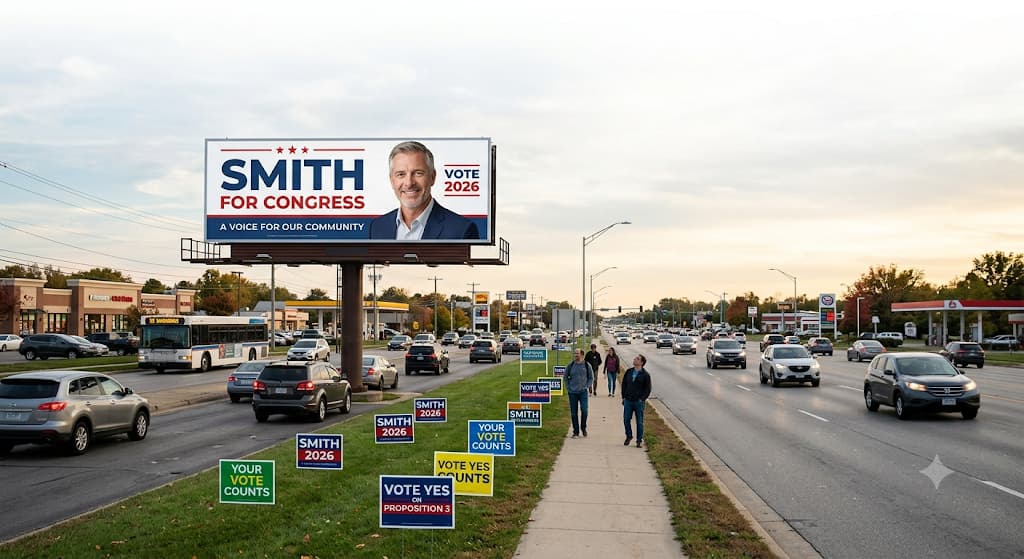

With 35% of Americans reporting mobile research after seeing OOH ads, campaigns have reason to test whether public visibility can produce measurable voter action.
What to Know
- 35% researched an advertised product or service on their phone after seeing an OOH ad, revealing a consumer response pattern that campaigns must test rather than assume.
- 47% notice OOH advertising at least several times a week, giving campaigns repeated visibility beyond content voters actively choose.
- Billboards lead all measured formats at 68%, followed by signs at 59%, rewarding creative that communicates within seconds.
- 68% of likely voters reported encountering political OOH advertising, demonstrating broad recalled exposure without proving that the ads changed voter preferences.
- Projected political advertising spending of $11.6 billion in 2026 increases pressure to test channels that add local reach instead of duplicating impressions.
Campaigns will compete across broadcast television, connected television, digital platforms, streaming audio, direct mail, and field programs in 2026. AdImpact projects total political advertising spending of $11.6 billion, which would set a cycle record. That pressure makes incremental reach more valuable as target voters divide attention across screens and services.
Out-of-home advertising provides public visibility along roads, transit routes, retail areas, and other locations. Consumer data shows that OOH can prompt commercial follow-up, but it does not show that voters research candidates or change preferences in the same way. The campaign case therefore rests on testing whether OOH adds recognition or response within a political media plan.
Repeated Exposure Builds Candidate Recognition
YouGov Profiles draws on continuously collected rolling surveys between July 2025 and July 2026, using nationally representative data from adults age 18 and older. It reports that 26% of American adults notice OOH ads several times a week and 21% notice them multiple times daily. Only 3% say they never notice the medium, showing how rarely OOH disappears from reported daily experience.
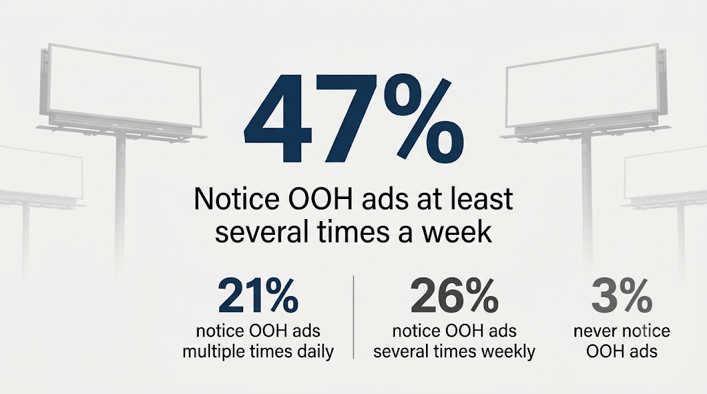
47% notice OOH advertising at least several times weekly.
Frequency matters because candidate names, issue contrasts, and voting instructions often compete with many other messages. A commuter who passes the same placement during a routine trip can receive repeated exposure without opening an app or selecting political content. That repetition can reinforce television, mail, digital, and field contacts, although the survey does not measure resulting vote choice.
Campaign managers should therefore treat frequency as an opportunity, not a guaranteed outcome. Placement quality, route selection, creative clarity, and timing determine whether repeated contact becomes recognition or background clutter. Understanding which formats receive the most attention is the next step toward converting frequency into useful campaign visibility.
Billboards Reward Immediate Message Clarity
Billboards lead the measured formats, with 68% of American adults saying they notice them. Signs follow at 59%, while point-of-sale displays and posters each reach 31%. YouGov also reports that digital interactive displays register 26%, providing several options for matching campaign objectives with available inventory.
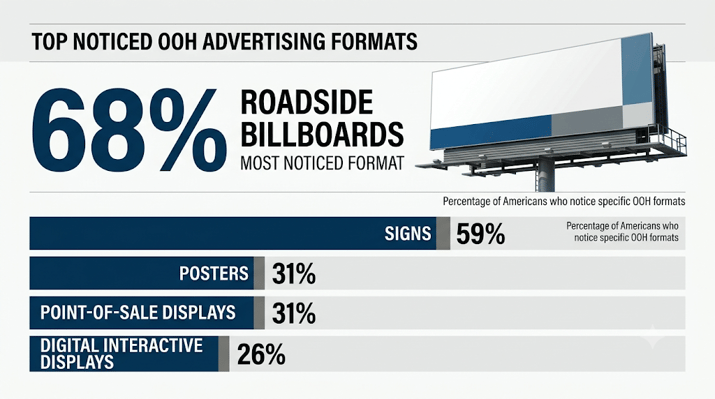
Campaign Now (Gemini), billboards lead OOH formats at 68%.
These rankings strongly favor campaign creative that communicates quickly. A strong political placement identifies the candidate, communicates one benefit or contrast, and gives viewers one memorable next step. Dense policy language, multiple calls to action, or weak visual hierarchy can waste the attention that a prominent location creates.
Placement quality also depends on the surrounding visual environment. A heavily traveled corridor may offer large impression totals while placing the campaign beside competing billboards, commercial signs, and other political messages. Media buyers should review nearby inventory and visual clutter because repeated exposure has limited value when voters cannot distinguish one message from the next.
Format selection should follow the job assigned to the placement. Large roadside units can build name recognition across major travel routes, while posters or digital displays can reinforce an event, deadline, or message in concentrated public settings. Once the creative earns attention, the more important question is whether exposure leads people toward additional action.
Public Exposure Can Trigger Private Action
Mobile research is the leading reported response in the YouGov results. 35% researched an advertised product or service on their phone, 20% discussed the brand with friends or family, and 19% made a mobile purchase. Store visits reached 15%, while taking a photo and researching through other means each reached 14%, showing that exposure often continues beyond initial notice.
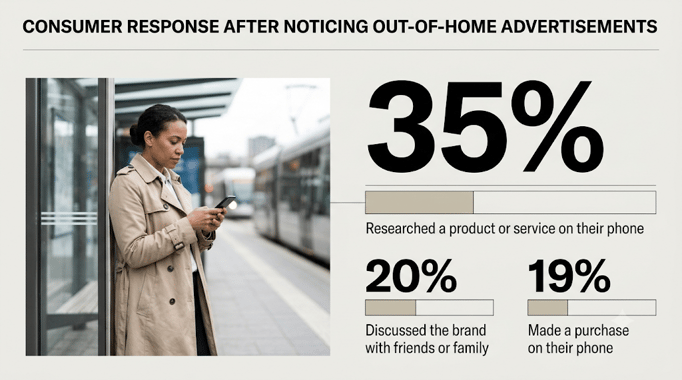
Campaign Now (Gemini), OOH exposure prompts measurable follow-up actions.
Direct-response behavior appears farther down the same hierarchy. 12% scanned a QR code or tapped an NFC tag, 11% redeemed a mobile voucher or downloaded an app, and 10% texted or called for information. Smaller shares purchased online without a mobile device, interacted with a brand on social media, or shared related content online.
Consumer actions do not establish that a political advertisement changes candidate support. Party identity, prior beliefs, and issue preferences make voting decisions different from many commercial choices. The findings instead show that OOH can prompt follow-up, which campaigns must verify through political measures.
Response design should match the placement. High-speed roadside billboards should use a short candidate name, memorable search phrase, or simple URL that viewers can recall later. QR codes, NFC tags, and text prompts belong on transit platforms, shelters, pedestrian displays, and other locations where viewers can safely pause.
Campaigns should define the desired action before production. Media buyers can compare searches, site visits, calls, registrations, or scans across formats and flight periods. These measures show engagement rather than persuasion, so polling, field reports, and broader media results remain necessary.
Political Findings Strengthen the Case With Limits
An OAAA and Morning Consult survey found that 68% of likely voters had seen, heard, or read political advertising through OOH. Half had encountered a political OOH ad within the previous month. Among respondents exposed during the previous year, 49% called the ads personally influential and 56% trusted their political information.
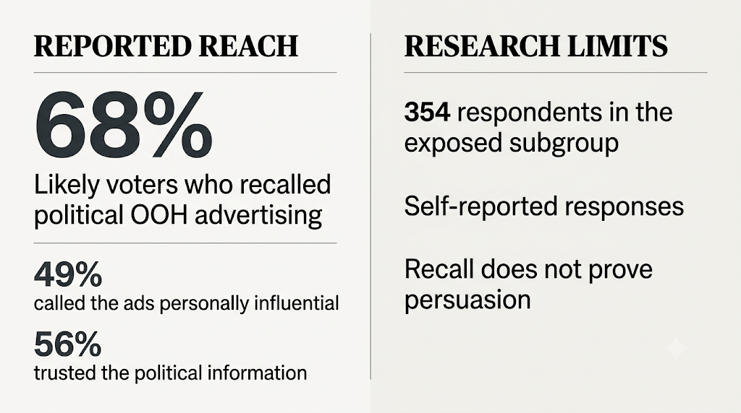
Campaign Now (Gemini), political OOH shows reach, not causation.
Other results show how voters described the medium’s role. 45% agreed that political OOH helped inform them about candidates, while 44% said it helped inform them about policy issues. Another 26% said it reminded them of voting’s value, and 21% said it generated interest in researching candidates or issues.
The survey adds political relevance, but its design limits the conclusion. Morning Consult interviewed 1,616 likely voters ages 18 through 64 online in February 2024. The 49% influence and 56% trust figures came from 354 respondents who recalled political OOH exposure during the previous year.
Because that subgroup was defined by remembered exposure, the results may reflect recall or selection effects alongside advertising response. The industry-sponsored survey measures self-reported influence rather than observed changes in support, persuasion, or turnout. Its findings justify further testing, but they cannot establish that OOH caused voters to become more engaged.
Geographic Planning Makes OOH Testable
OOH trades voter-level targeting precision for broad geographic visibility. Addressable digital and television media can match advertisements more closely to selected households or voter audiences, while a physical placement reaches nearly everyone who passes it. That spillover can raise the effective cost per qualified voter even when the billboard’s overall impression cost appears competitive.
Campaign managers should use OOH where location provides strategic value that household media cannot reproduce. A defined test budget should focus on routes and public locations that over-index for target voters, remain relevant to the district, and reinforce messages delivered through addressable channels. Performance should be judged by incremental reach, response quality, and cost instead of raw impressions alone.
Measurement needs a comparison, not just an impression estimate. Unique URLs, phone numbers, search monitoring, and geographic lift tests can identify response when a campaign has enough traffic and a stable baseline. Smaller down-ballot campaigns may lack the volume or analytics capacity to separate OOH effects from mail, field work, digital advertising, and other activity running at the same time.
Feasibility depends on inventory, price, district geography, visual clutter, and enough response volume to support interpretation. A low-cost unit may still perform poorly when most viewers fall outside the qualified electorate or when nearby messages dilute attention. Smaller campaigns should use modest tests and directional evidence rather than claiming precise attribution that their data cannot support.
Wrap Up
OOH combines repeated public exposure with a documented pattern of follow-up behavior. Billboards and signs can build recognition, while search, scans, calls, and visits can move interested viewers into channels that campaigns already measure. Political findings strengthen the case for testing, although they do not establish causal persuasion.
Campaign managers should reserve a defined OOH test budget where voter geography and travel patterns support meaningful exposure. Each placement should carry one message, connect to a trackable action, and use the same strategic theme as television, digital, mail, and field programs. Expansion should depend on incremental reach, response quality, cost, and the placement’s contribution to the campaign objective.