
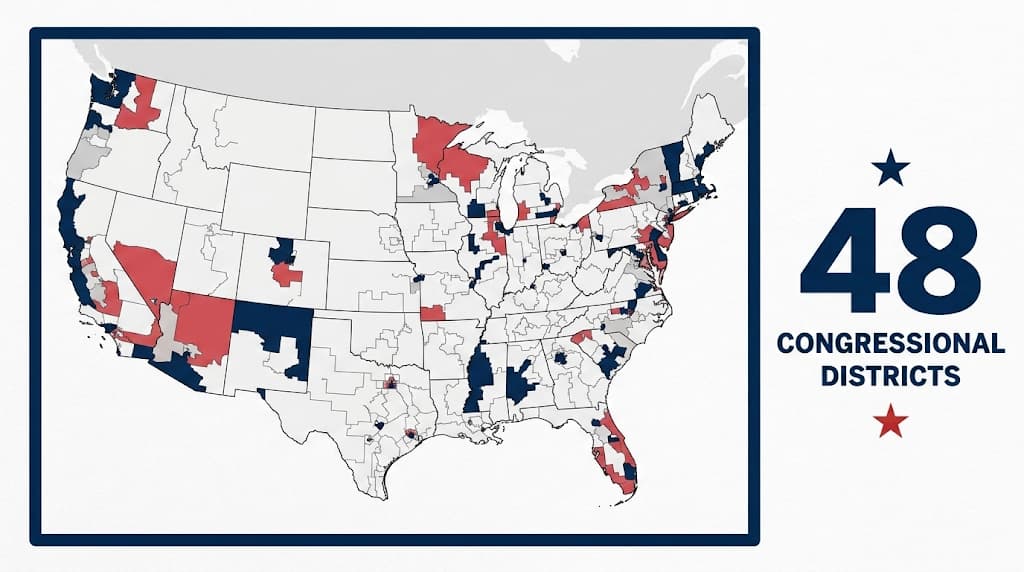

Republicans face a defensive House map shaped by national pressure, shifting boundaries and increasingly concentrated campaign resources nationwide.
What to Know
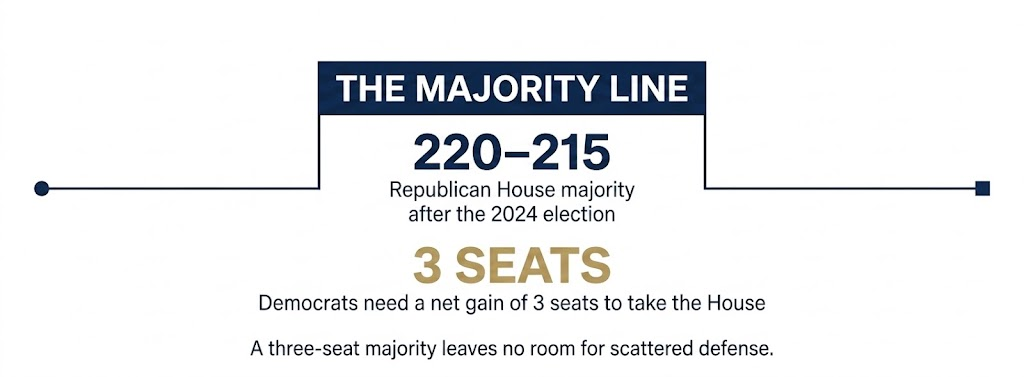
- Republicans won a 220–215 House majority in 2024, meaning Democrats need a net gain of only 3 seats to take control.
- Silver Bulletin identifies 48 districts where the opposition has at least a 25% chance of winning.
- Cook Political Report lists 21 Toss-Up House races, including 16 Republican-held seats.
- Inside Elections also puts Republicans on defense in 13 of its 16 Toss-Up districts.
- A national Democratic popular-vote advantage of about 3 points would make Democrats favored to win the House in Silver Bulletin’s model.
Republicans do not have the luxury of a broad cushion. They won a 220–215 House majority in 2024. That gives Democrats a simple path to power: a net gain of 3 seats. If Democrats reach that number in November, they take the House majority, elect the speaker and control the chamber’s committees.
That arithmetic should govern every strategic decision. A campaign can survive a difficult district. A party holding a three-seat majority cannot survive too many difficult districts at once.

Nate Silver, statistician and founder of Silver Bulletin.
Silver Bulletin’s tour of the 48 key House races turns that warning into a map. Its FLIPR Deluxe forecast includes every district where the opposition party has at least a 25% chance of winning. Some are close contests. Some reflect redistricting. Some are long-shot opportunities that could become real if the national environment shifts further.
The point is not that all 48 seats will flip. The point is that the battlefield is wide enough to punish scattered strategy.
Republicans Carry the Larger Defensive Burden
Independent ratings do not reproduce Silver Bulletin’s full paywalled list. They do confirm its central conclusion: Republicans must defend more of the House’s most vulnerable districts.
A 270toWin table of Cook Political Report ratings, updated August 25, lists 21 Toss-Up contests. Of those, 16 are Republican-held and 5 are Democratic-held. That is not a cosmetic imbalance. It means Republican candidates, committees and allied organizations must make more correct decisions across more districts as Election Day approaches.
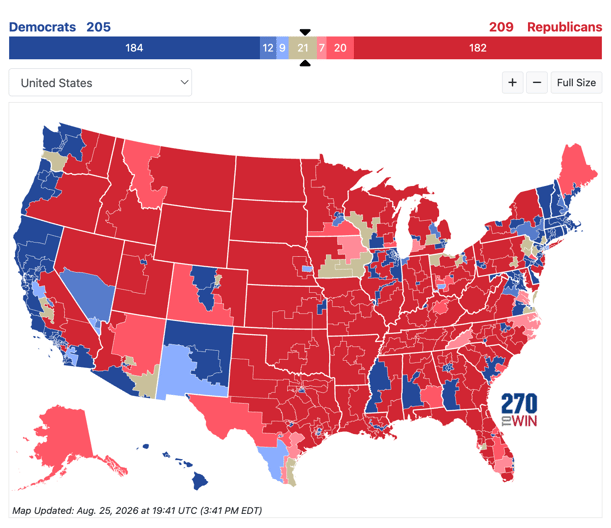
Republicans defend 16 of Cook Political Report’s 21 Toss-Up districts.
Inside Elections’ September 3 ratings point in the same direction. It identifies 16 Toss-Up districts, 13 of them held by Republicans. Different forecasters draw the battlefield differently. Both see a Republican majority with more exposed territory to protect.
That exposure crosses regions. Cook places Arizona’s First and Sixth Districts, Colorado’s Eighth, Iowa’s First and Third, Michigan’s Seventh, New York’s Seventeenth, Pennsylvania’s Seventh, Eighth and Tenth, Virginia’s Second, Washington’s Third and Wisconsin’s Third among its Toss-Ups. A party cannot solve that map with one television buy, one issue message or one regional strategy.
The threat is national because the districts are national.

Thomas Kean Jr. and Rebecca Bennett contest New Jersey’s Seventh District.

Sue Altman, 2024 Democratic nominee for New Jersey’s Seventh District.
New Jersey’s Seventh District shows the problem in miniature. Republican Rep. Thomas Kean Jr. holds a seat that Cook rates Toss-Up and Inside Elections rates Tilt Democratic. The district does not stand alone. It belongs to a larger group of suburban and competitive districts where a modest national movement could prove decisive.
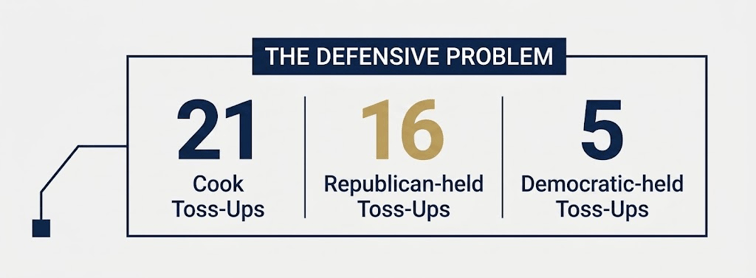
Republicans do not need to lose every Toss-Up to lose the House. They need only lose enough of them at the same time.
The National Environment Can Break a Narrow Majority
District campaigns matter. So do candidates, local issues and field operations. But a three-seat majority remains vulnerable to a national political current.
Silver Bulletin estimates that the revised House map leans Republican by several points. Its key threshold is clear: Democrats become favored to win the House when they win the national House popular vote by about 3 points. Below that, the model treats them as underdogs. At or above that margin, the path to a Democratic House majority becomes much more plausible.
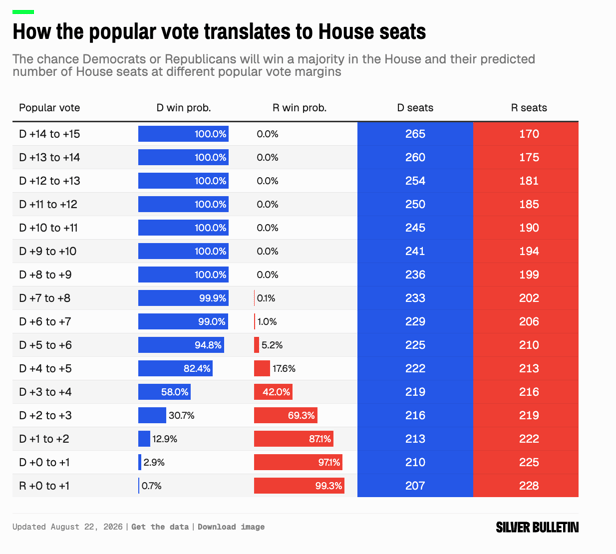
A Democratic popular vote lead near three points changes House control.
Current polling makes that threshold impossible to ignore. An Emerson College Polling survey conducted August 16–17 found Democrats leading the generic congressional ballot 51% to 43% among likely voters, with 6% undecided. One poll does not predict November. Its sample of 1,000 likely voters also carries a stated credibility interval of plus or minus 3 percentage points.
Still, the strategic implication is immediate. Republicans cannot assume the national environment will rescue an exposed incumbent. They must build district plans capable of holding up when national conditions become less friendly.
The wrong response is panic spending. The wrong response is also complacency.
Campaigns need to separate seats into three groups: core defenses that directly protect the majority, credible pickup opportunities that can offset losses and lower-probability contests that should receive resources only when new evidence justifies them. That evidence can include independent polling, fundraising performance, voter-contact data, public advertising activity and a documented change in the district’s political environment.

The majority will not be lost because one forecast produced a difficult headline. It will be lost if too many campaigns react too late to the same national warning.
Redistricting Moved the Map, but It Did Not End the Fight
Redistricting changed the House battlefield before many general-election campaigns began. In Texas, Republican lawmakers adopted new lines intended to improve GOP prospects. California voters approved a competing Democratic map designed to offset part of that advantage. Associated Press reporting describes a national mapmaking fight in which both parties tried to improve their starting position before voters cast a ballot.
The Republican advantage is real in some newly drawn southern districts. Silver Bulletin’s tour recognizes that several GOP pickups are so favorable that redistricting makes them close to certain. Those seats matter. They may give Republicans a route to replace losses elsewhere.
But redistricting does not repeal political gravity.
A new district line cannot make an unpopular message persuasive. It cannot reduce a challenger’s fundraising advantage. It cannot stop a national swing from reaching existing Republican seats in the Northeast, Midwest and West. It also cannot guarantee that courts, election administrators and voters will treat every redrawn line as permanent or politically settled.
That is why map gains should be treated as part of the majority strategy, not as a substitute for it. Republican opportunities in the South can offset losses. They cannot erase the need to defend the districts already holding the House together.
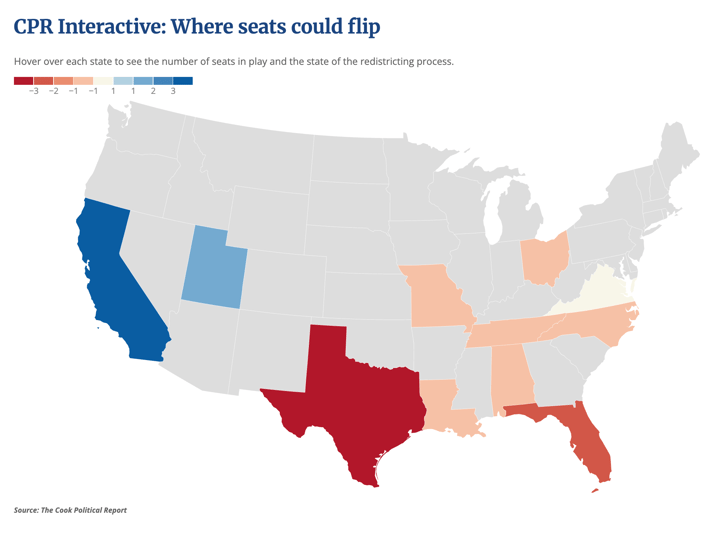
Redistricting shifts potential gains across a changing House map.
The practical task is to understand each district’s role. A new Republican opportunity may warrant a targeted investment. A veteran incumbent in a Toss-Up may require a deeper field, fundraising and media commitment. A district with unresolved boundaries or a late legal challenge may require contingency planning and updated voter files.
Mapmaking changes where campaigns compete. It does not remove the need to compete well.
Resources Must Follow the Shortest Path to 218
The 48-race list can tempt campaigns to treat every competitive district as equal. They are not equal.
A district at the center of Democrats’ shortest path to a net gain of 3 deserves a different level of attention than a district that merely meets a 25% probability threshold. Party target lists, candidate recruitment lists and statistical forecasts serve different purposes. A broad target list can help recruit candidates and raise money. A focused majority plan must decide where limited resources will make the greatest difference.
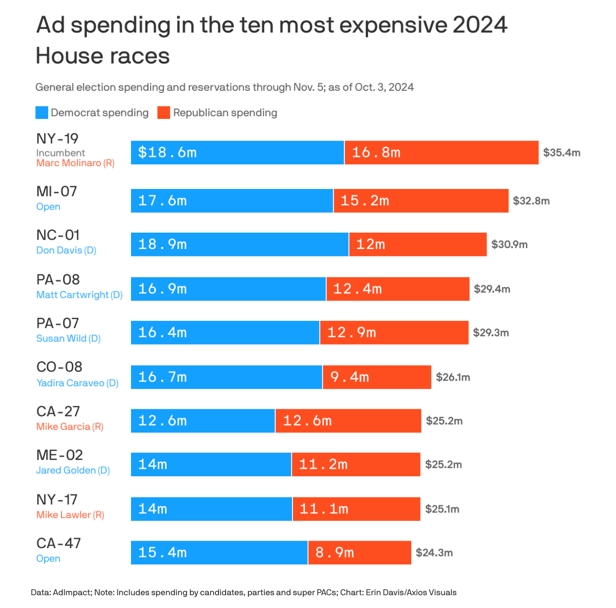
Ten House races attracted $283 million in 2024 advertising.

Donald Trump, 45th and 47th President of the United States.
Republicans should begin with the most exposed incumbent defenses, especially where independent ratings and district-level evidence point in the same direction. Next come the pickup opportunities that can realistically offset losses. Finally, committees should maintain a disciplined reserve for races that change because of late polling, fundraising, turnout patterns or a sudden shift in the national environment.
That approach requires coordination without pretending every campaign has the same needs. Candidate committees understand local voters, local media and local volunteer capacity. National organizations can compare districts, fund production and identify overlapping media markets. State parties can reinforce registration, early-vote and turnout operations. Each part of the coalition should solve the problem it is best positioned to solve.
Measurement must remain practical. Media teams should track persuasion reach, geographic delivery and excessive frequency. Field teams should track contact rates, volunteer capacity and legally available ballot-return patterns. Fundraising teams should distinguish a strong online day from sustained donor support. Campaigns should not let one weak internal poll or one dramatic social-media moment overrule a body of credible evidence.
The final months will reward discipline. A small majority does not allow committees to fund every compelling story, every viral challenger or every optimistic forecast. It requires choices.
Wrap Up
Silver Bulletin’s 48 key races tell a clear story. Republicans have opportunities, particularly in districts reshaped by southern redistricting. But Democrats have a broader set of paths through the Northeast, Midwest and West, and independent ratings place more Republican-held seats in the most competitive category.
The number that matters most is still 3. That is the net Democratic gain needed to take the House after Republicans’ 220–215 victory in 2024. A narrow majority turns ordinary campaign mistakes into national risks.
Republicans can keep the House. But they cannot treat every race the same, rely on redistricting alone or wait for the national environment to improve. The path to 218 begins with a hard truth: protecting the majority means defending the districts most capable of deciding it.


.jpg)