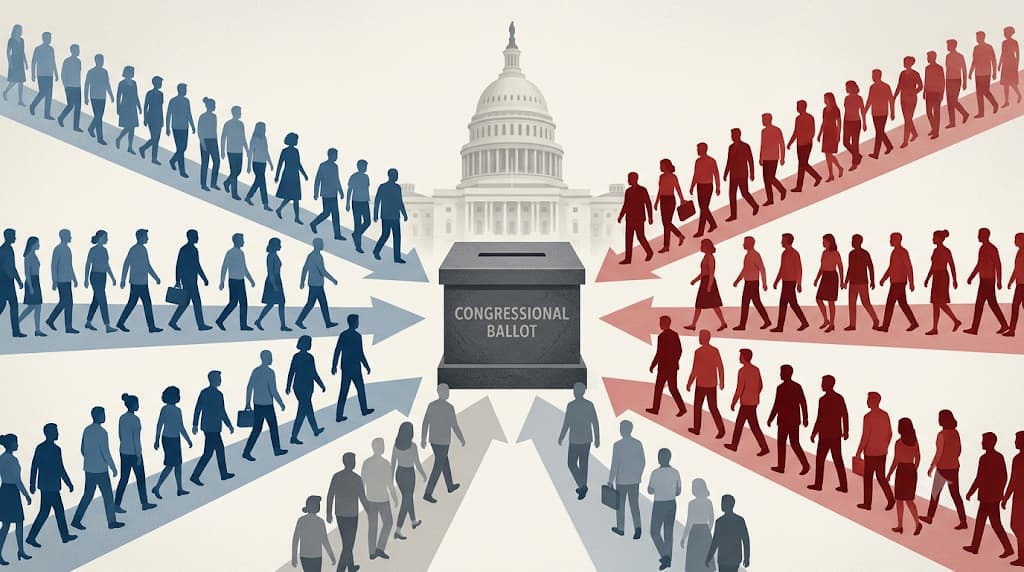


Public opinion on artificial intelligence and data centers is becoming a political battlefield, forcing tech companies to navigate a deeply divided electorate.
What to Know
- Artificial intelligence currently holds a net favorability rating of -9, far below traditional technology companies.
- Data centers sit at a net favorability rating of -2, with 38% of Americans holding no opinion.
- Nearly 70% of Americans express discomfort with large-scale data infrastructure projects being built near their communities.
- Support for AI is strongest among men, urban residents, higher-income voters, Black voters, and Hispanic voters.
- Opposition comes from unusual coalitions on both the political left and right, creating new challenges for infrastructure developers.
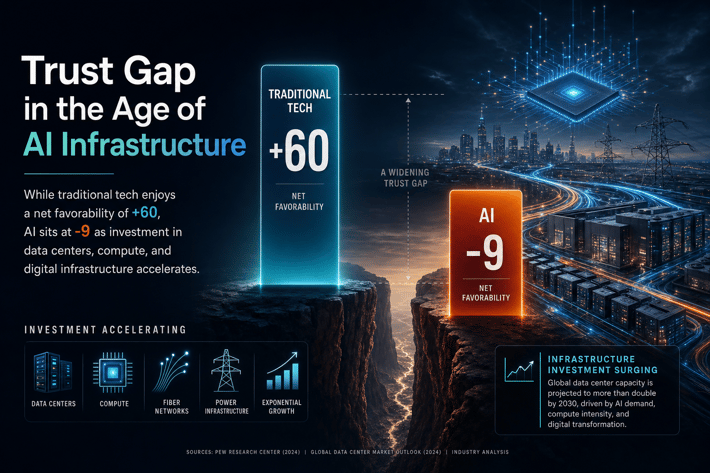
America's push to build the infrastructure powering the AI economy is running into an unexpected challenge: voters. New research from Echelon Insights shows a sharp contrast between public attitudes toward established technology companies and artificial intelligence itself. While traditional tech companies enjoy a net favorability rating of +60, AI carries a net favorability rating of -9, exposing a significant trust gap as investment in data centers, computing power, and digital infrastructure accelerates.
Behind those numbers is a larger political reality. Voters who eagerly embrace smartphones, online shopping, and streaming platforms are often far more cautious about technologies they believe could replace jobs, influence information, or concentrate power. Echelon's analysis identifies seven distinct voter tribes shaping public opinion on technology, energy, and finance, offering a roadmap for understanding which coalitions are likely to support, question, or resist the next phase of America's digital transformation.
Data Centers Move From Invisible to Controversial
The outlook for data centers is only slightly better. Nationally, data centers register a net favorability rating of -2, but the more important number may be the 38% of Americans who report having no opinion at all. That neutrality creates opportunity and risk. Infrastructure developers often benefit when projects remain abstract.
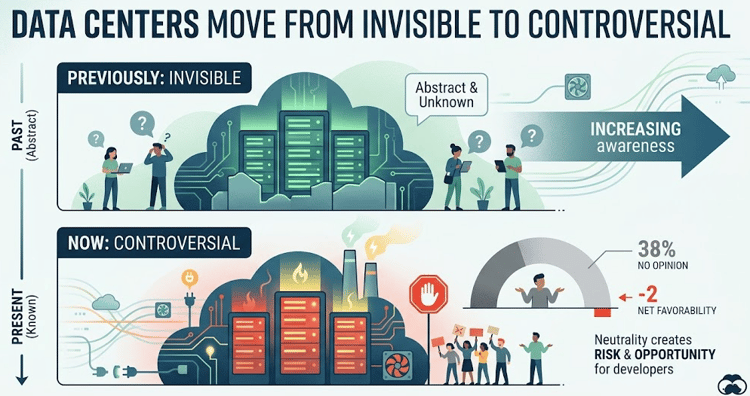
Once proposals become local, however, opposition frequently intensifies. Concerns about energy consumption, water use, land development, and grid reliability suddenly become tangible political issues. Recent public sentiment suggests that many voters become significantly more skeptical when a facility is proposed in their own community.
The Demographic Divide
Public attitudes toward artificial intelligence are becoming more nuanced than the conventional narrative of fear versus enthusiasm. According to polling from Echelon Insights, Americans are increasingly optimistic about AI's potential, with voters now more likely to say the technology will be helpful to humanity and improve their lives than they were just two years ago. Concerns remain, but the overall trend points toward growing acceptance as AI becomes a larger part of everyday life.
Beneath that optimism, however, clear divides remain. Younger voters and college-educated Americans are driving much of the shift toward AI acceptance, while older voters continue to express greater uncertainty and concern about its long-term impact. Echelon's findings also show strong support for government oversight across demographic and partisan groups, suggesting voters are becoming more comfortable with AI itself while simultaneously demanding safeguards to ensure the technology serves the public interest.
Opposition Comes From Both Sides
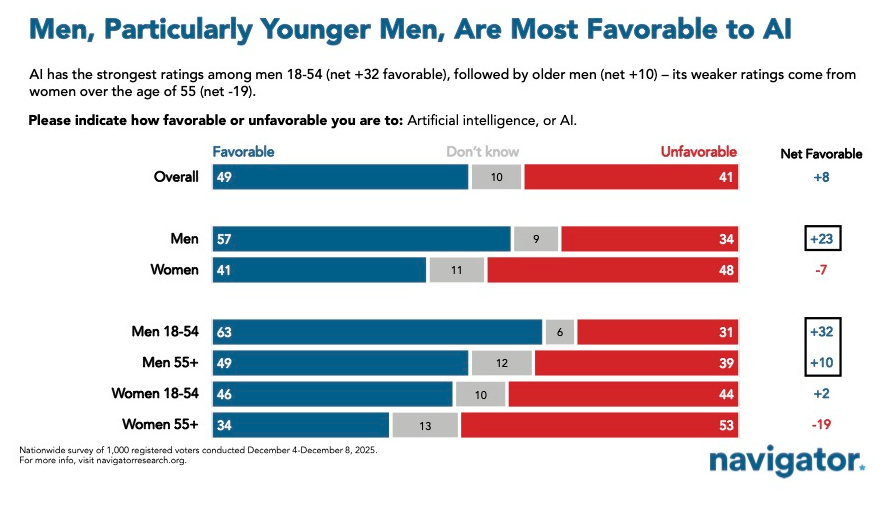
Public opinion on AI is far from settled. Navigator Research found 49% of Americans view AI favorably, but support is strongest among younger voters, men, college graduates, and higher-income households. Men under 55 are particularly supportive, with 63% holding favorable views, while women overall remain more skeptical, with 41% favorable and 48% unfavorable. Notably, 50% of Americans report using AI tools at least once a week, and frequent users tend to view the technology more positively.
Screenshot of chart from Navigator Research
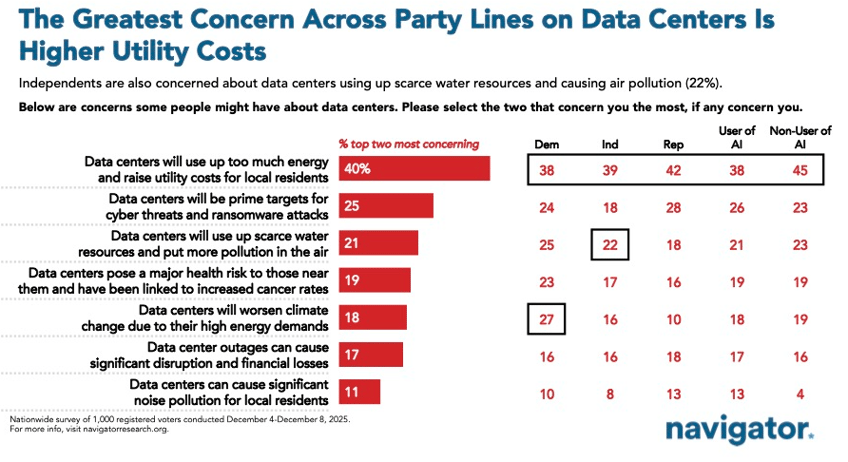
The infrastructure behind AI faces an even bigger challenge. Only 36% of Americans support building a data center in their community, while 32% oppose it and 32% remain undecided. Concerns about energy use, rising utility costs, and environmental impacts outweigh ideological objections. At the same time, voters respond positively to promises of good-paying jobs and local economic growth, favoring responsible development over efforts to halt construction altogether.
Why Nuclear Energy May Become Part of the Solution
As demand for AI infrastructure grows, energy policy is becoming inseparable from technology policy. One finding stands out. Nuclear energy maintains relatively strong bipartisan support compared to many other energy sources. Pro-growth voters across multiple political tribes view nuclear power favorably because it offers large-scale energy production without many of the emissions concerns associated with fossil fuels.
Screenshot of chart from Navigator Research
For data center developers, that creates a potential pathway forward. Linking future infrastructure projects with reliable nuclear energy sources may help address concerns about grid strain, electricity costs, and long-term sustainability. In many communities, energy reliability has become just as important a political issue as technological innovation itself.
Campaigns Must Adapt to a New Political Reality
National leaders are already framing AI in political terms. During a June 2026 Senate hearing, Secretary of State Marco Rubio warned that AI-driven job displacement is "not just an economic issue, that is a political issue" and could eventually "destabilize societies all over the world" if workers are not equipped with new skills and opportunities.

U.S. Secretary of State Marco Rubio
Meanwhile, President Donald Trump has argued that America leads the AI race because it refuses to "stifle this innovation with overly burdensome regulation," while acknowledging that "advanced AI capabilities make our Nation stronger" even as they introduce new national security challenges.

President Donald J. Trump; photo via White House
For campaigns, policymakers, and developers, the lesson is clear: technology policy is becoming voter policy. Winning support for AI infrastructure will require more than promises of innovation. Success will depend on addressing the specific concerns of individual communities and demonstrating how technological growth benefits the people who live there.
Wrap Up
Artificial intelligence and digital infrastructure are rapidly becoming defining political issues. What once seemed like technical discussions about servers, data storage, and computing power now intersect directly with concerns about jobs, energy, privacy, and community development. The result is a political environment where public opinion may become just as important as technological capability.
Looking toward 2026 and beyond, candidates at every level of government will increasingly face questions about data centers, energy demand, artificial intelligence, and economic transformation. The organizations that succeed will not simply be those with the most advanced technology. They will be the ones that understand the voter coalitions shaping the future of America's digital economy and build support before the next infrastructure battle begins.