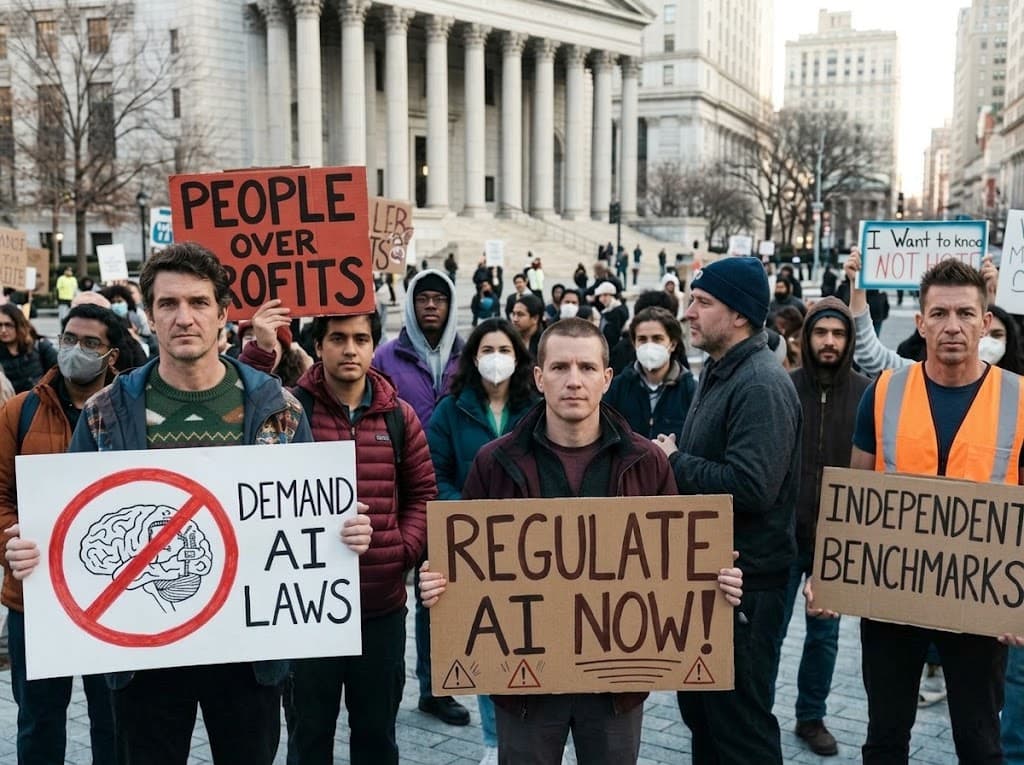

Voters increasingly fear advanced artificial intelligence and distrust corporate safeguards, creating broad political demand for independent federal oversight.
What to Know
- 73% of U.S. adults are very or somewhat concerned that future AI systems could threaten human survival.
- 86% support independent safety standards for AI companies, even when the standards slow development.
- 74% have little or no trust in leaders of AI companies.
- 77% want powerful AI development stopped or slowed until safety can be evaluated.
- 71% of registered voters say they are more likely to support candidates who favor stricter AI guardrails.
Artificial intelligence has moved beyond a niche technology debate. Voters now connect it to safety, personal trust, local infrastructure and the authority of government to set limits. That shift gives candidates a real issue to address, but not a license to claim that every voter sees AI in the same way.
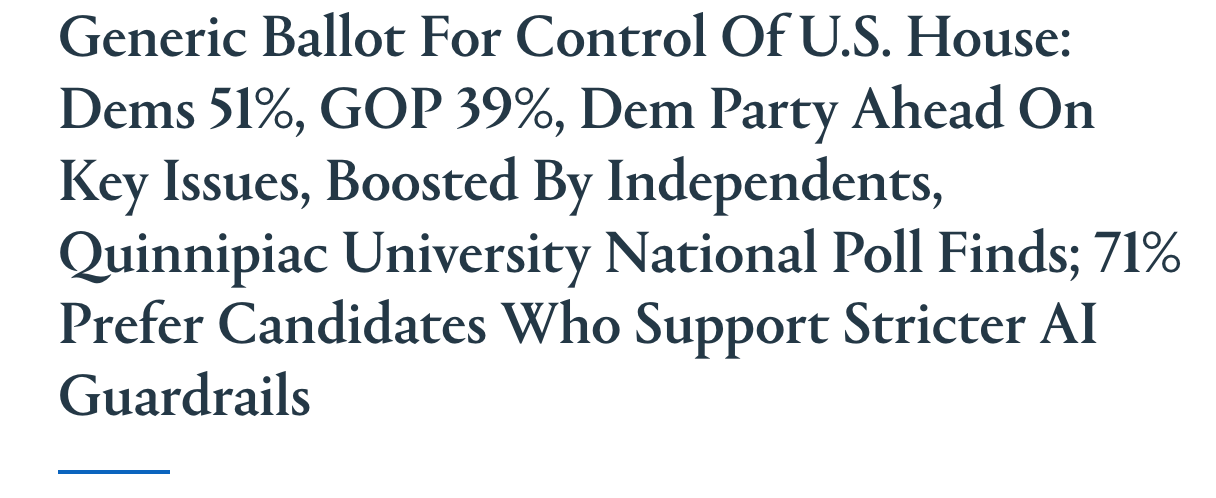
Quinnipiac University national poll release puts AI safety opinion in view.
Quinnipiac University’s September national survey of 1,202 adults found unusually broad concern about powerful future systems. A separate Quinnipiac voter survey of 1,032 registered voters found that 71% would be more likely to support a candidate who favors stricter AI guardrails, compared with 16% who prefer a candidate who supports expanding AI development. Those results show a clear demand for safeguards, yet campaigns still need to explain what a guardrail would do, who would enforce it and how it would protect voters.
Public Concern Is Real, but Human Misuse Remains the Larger Fear
Quinnipiac found that 73% of adults were very or somewhat concerned that future AI systems could threaten human survival. That is a serious warning for technology companies and elected officials, but it should be described precisely as concern about a potential future danger, not evidence that rogue systems have caused a real world catastrophe. Equally important, respondents were more concerned about people using AI to harm humanity than about autonomous AI agents causing harm, 52% to 33%.
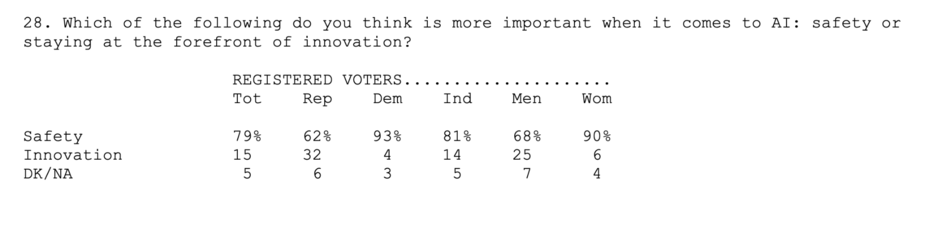
Americans report broad concern about future artificial intelligence survival risks. via Quinnipiac poll
That distinction changes the campaign argument. Voters may want protection from fraud, cybercrime, deceptive content, discrimination and reckless deployment just as much as they fear a hypothetical loss of human control. Candidates who rely only on dramatic language about machines taking over risk missing the everyday harms that concern a larger share of the public.
Views about personal impact reinforce that point. A 53% majority said AI will do more harm than good in their day to day lives, while 34% said it will do more good than harm. Campaigns should not treat those findings as hostility toward every use of AI. They show that the burden has shifted to developers and officeholders to prove that concrete benefits outweigh credible risks.
Corporate Promises Cannot Close the Trust Gap
Distrust of industry leaders gives the safety debate its political force. Quinnipiac found that 74% of adults had little or no trust in the leaders of AI companies, including 45% who said they had no trust at all. Voluntary pledges may attract headlines, but they do not answer the voter demand for standards that operate independently of company promises.
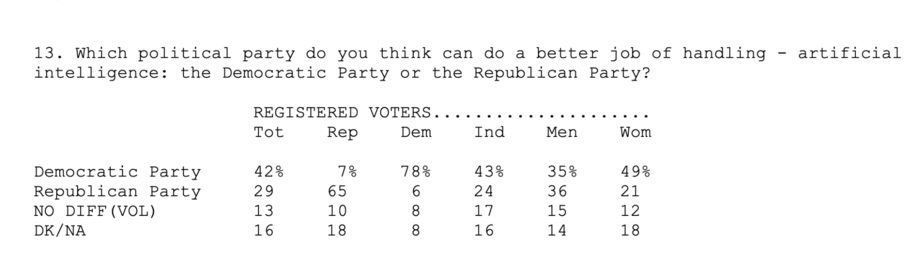
Independent safety standards draw broad support across every surveyed generation.via Quinnipiac poll
Support for enforceable safeguards was overwhelming. Fully 86% supported requiring companies developing AI systems to meet independent safety standards even if compliance slows development, and 91% said U.S. guardrails for AI are at least somewhat important. Another 77% said companies should stop or slow development of powerful systems until their safety can be evaluated, compared with 19% who preferred the current pace or faster development.
Campaigns should translate those figures into a testable policy choice. Voters need to know whether a candidate supports independent evaluations, disclosure requirements, liability rules, agency enforcement or a different mechanism. Calling for responsible AI without naming an enforceable standard will not overcome the public’s skepticism of corporate self policing.
Competition Does Not Cancel the Demand for Limits
Safety support does not mean voters want the United States to abandon competition with China. Quinnipiac found that 69% considered keeping up with China in AI development important, and 65% said both competition and guardrails mattered. Voters are not choosing a simple anti technology position. They are demanding a strategy that treats safety and national competitiveness as parallel obligations.
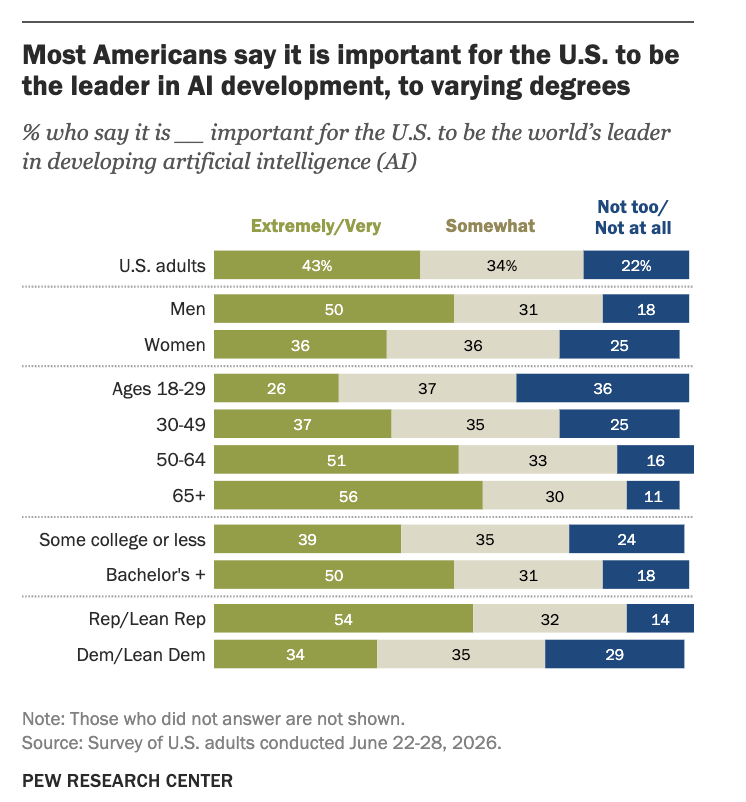
Most Americans consider United States leadership in artificial intelligence important.
Data centers show where national policy becomes local politics. In the adult survey, 72% said they would oppose an AI data center in their community, compared with 21% who would support one. The registered voter survey found comparable opposition across party groups, with 85% of Democrats, 76% of independents and 55% of Republicans opposed.
That local resistance should not be treated as opposition to all computing infrastructure. It does show that candidates need clear answers on electricity demand, water use, land, tax incentives, local jobs and who pays for grid upgrades. A national innovation message will not resolve a neighborhood dispute if residents believe they will bear the cost.
Wrap Up
AI safety has become a voter trust issue because concern extends beyond the technology itself to the people and institutions controlling it. Quinnipiac’s findings show strong support for independent standards and significant doubt that industry leaders can police themselves. Campaigns that dismiss those views as alarmism risk leaving a broad concern unanswered.
Candidates also should not exaggerate what the survey proves. Concern about future systems is not proof that voters endorse every proposed restriction, and a preference for guardrails does not identify a single winning bill. Credibility will depend on whether candidates describe a specific safeguard and its practical effect.
Winning campaigns will connect AI governance to voter consequences. That means addressing fraud and harmful uses of AI, explaining independent oversight and responding to the utility and land pressures created by data centers. Voters are asking for control, not empty promises of either unchecked acceleration or permanent paralysis.
.jpg)
-Oct-08-2026-08-37-48-9565-PM.jpg)