


New data shows campaigns are clinging to outdated demographic targeting for streaming ads, missing more effective ways to persuade and mobilize voters in the new media landscape.
What to Know:
- Campaigns are misusing CTV by overrelying on outdated demographic targeting, despite nearly 30% of marketers prioritizing it.
- Broad age and gender proxies undermine persuasion and turnout, driving substantial wasted spend.
- Contextual targeting is largely ignored, with only 11% of buyers prioritizing ads based on what viewers are actually watching.
- High-impact interactive CTV ads, shown to lift brand recall by 36%, remain underused.
- Habit, weak data standards, and programmatic convenience are locking campaigns into ineffective strategies.
Political campaigns are pouring record sums into Connected TV (CTV), chasing voters who have cut the cord from traditional television. They are operating under the promise that CTV offers the best of both worlds: the high impact of a television ad with the precision targeting of a digital campaign.

This strategic inertia, detailed in new reports and data from eMarketer and Gracenote, shows that campaign media buyers are clinging to the comfort of age, gender, and income proxies in a media environment that allows for far more sophisticated approaches. Campaigns are wasting millions by failing to use contextual and interactive CTV strategies, missing key voters with their message, and misjudging this vital new political medium.
The Broken Promise of ‘Better TV Targeting’
The rush to CTV was driven by a clear and correct diagnosis: the audience for linear television is shrinking and aging, and campaigns needed to find voters, particularly younger ones, on the streaming platforms where they now spend their evenings.
Platforms like Hulu, Roku, and Peacock became the new battlegrounds, and the promise was that digital targeting would allow campaigns to finally move beyond the blunt instrument of buying ads on "60 Minutes" or "NCIS" and instead reach specific households with tailored messages.

However, the execution has failed to live up to this promise. Rather than embracing new methods, media buyers have largely ported their old playbook into the new ecosystem. The dominant strategy has been to buy ads against broad demographic segments like "females 35-54" or "males 18-34." Recent data from Gracenote is stark: nearly 30% of brand and agency professionals prioritize this kind of demographic targeting for their CTV ads. This approach is nearly three times more popular than contextual targeting, which is prioritized by a meager 11% of buyers.
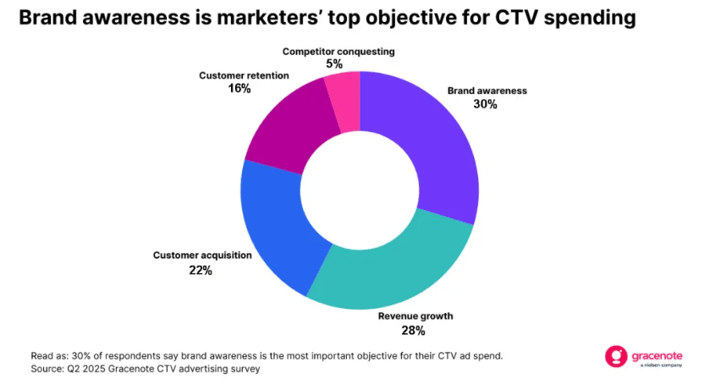
Screenshot taken from Gracenote
This isn't happening because demographics are effective; it's happening because they are easy. Programmatic ad buying platforms, which automate the process of purchasing ad inventory at scale, are built around these familiar segments. For overworked campaign staff and media firms managing dozens of races, defaulting to simple demographic buys is the path of least resistance. The result is that campaigns are treating a revolutionary new medium like an old one, and they are paying a steep price for that lack of imagination.
Why Demographic Targeting Fails in the Streaming World
The core problem with a demographic-first strategy is that basic data points like age and gender are terrible proxies for political behavior. For instance, knowing a voter is a 45-year-old woman tells you absolutely nothing about whether she is a committed partisan, a persuadable swing voter, a MAGA Republican, or a progressive Democrat.
It does not tell you if she cares more about the economy, abortion rights, or foreign policy. Targeting her based on demographics alone is the digital equivalent of shouting into a crowded room and hoping the right person hears you. This inefficiency is magnified in the deeply fragmented world of CTV. Unlike linear television, where a few major networks dominated, the streaming ecosystem is a chaotic landscape of hundreds of different apps and channels.
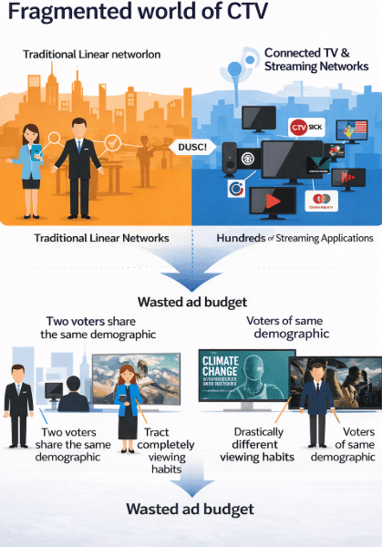
Two voters who fall into the exact same demographic bucket can have viewing habits that reflect completely opposite political worldviews. One might spend their evening watching a conservative news commentary channel on Pluto TV, while the other streams a documentary on climate change on Netflix. A campaign that buys a broad demographic target will inevitably waste a huge portion of its budget showing ads to people who will never vote for their candidate.
This is a critical failure because it misaligns with the two primary goals of any political ad campaign: persuasion and turnout. Time suggests that to persuade a voter, you need to find someone who is actually undecided and open to changing their mind. To turn out a voter, you need to find someone who is already in your camp and needs a final push to cast their ballot.
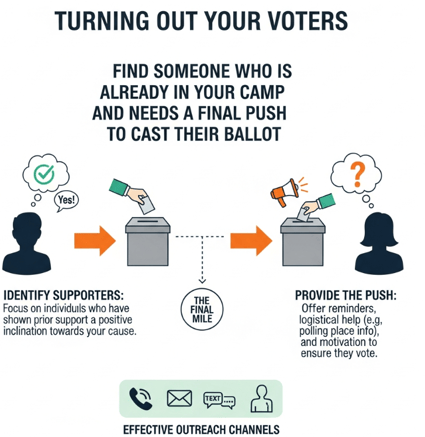
A voter's age or income bracket is a poor indicator of either of those states. Behavioral data (like past voting history) and contextual data (the content they choose to watch) are far more powerful signals, yet they remain critically underutilized.
The Untapped Power of Context and Interaction
The strategic failures of demographic buying are made even more glaring by the powerful and proven alternatives that campaigns are leaving on the table. The most significant of these is contextual targeting. Instead of buying an audience based on who they are, contextual targeting allows campaigns to buy an audience based on what they are watching at that exact moment. This ensures a level of message alignment that is impossible to achieve with demographics.
For example, a Republican campaign running on a message of fiscal responsibility could place its ads exclusively on business and finance news channels available through streaming services. A Democratic campaign focused on environmental issues could target its ads to run during nature documentaries and programs about climate science.
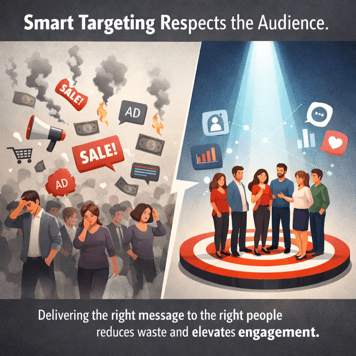
This approach ensures that the ad is being seen by a self-selecting audience of viewers who have already demonstrated an interest in a relevant topic. It respects the viewer's intelligence and dramatically reduces the waste of showing ads to an irrelevant audience. The fact that only 11% of media buyers are prioritizing this strategy represents a massive, unforced error.
From Passive Viewing to Political Action
An even more advanced and underused opportunity lies in interactive CTV advertising. For decades, television ads have been a one-way street: the campaign speaks, and the voter passively listens. Interactive formats change that dynamic entirely. These are ads that feature elements like on-screen QR codes that a viewer can scan with their phone, or overlays that allow them to click for more information using their remote. This technology transforms the ad from a passive message into a direct call to action.
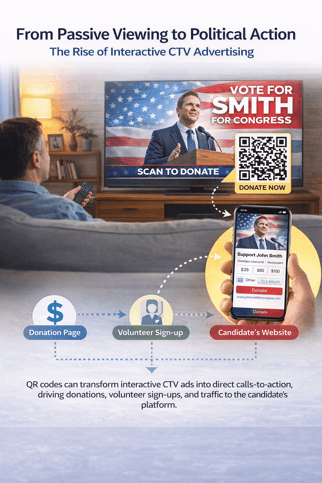
The performance uplift from these formats is not theoretical. For a political campaign, the applications are obvious and powerful. A QR code in an ad could take a motivated viewer directly to a donation page, a volunteer sign-up form, or the candidate’s website to learn more about their platform. This closes the gap between seeing an ad and taking a political action, making the campaign's largest screen ad buy directly measurable and actionable.
Wrap Up
The widespread reliance on demographic targeting for CTV is not just a tactical mistake; it is a symptom of a larger strategic failure. Campaigns are pouring billions of dollars into a new and complex media environment while clinging to the outdated assumptions of a bygone era. They are treating CTV as "television with better targeting" when they should be treating it as an entirely new channel that demands its own unique strategy, one built on understanding context and encouraging interaction. The current approach is lazy, inefficient, and demonstrates a profound lack of respect for how voters actually consume media in the modern age.
Looking ahead to the 2026 midterms, the campaigns that break from this inertia will have a significant competitive advantage. Media planners must demand more from their vendors, pushing for better contextual targeting capabilities and piloting interactive ad formats now to build expertise. They need to shift their entire mindset, moving away from buying broad audiences and toward reaching specific voters at the moments they are most receptive.