
Alexandria Ocasio-Cortez’s opening is real, but calendar rules, coalition breadth and credibility will determine whether progressives can capitalize nationally.
What to Know
- Representative Alexandria Ocasio-Cortez has not announced a 2028 campaign, but her national profile gives her a potentially strong progressive lane.
- Democrats will begin their 2028 presidential calendar in South Carolina before voting in Nevada, New Hampshire, New Mexico, Michigan and Virginia.
- Candidates generally must reach 15% statewide or within a qualifying district to receive delegates under the party’s proportional allocation rules.
- Bernie Sanders and Zohran Mamdani strengthen the progressive movement, but neither appears positioned to contest the 2028 Democratic nomination.
- Artificial intelligence, data center expansion and economic displacement could create a defining policy contrast among prospective Democratic candidates.
Democratic politics after 2024 has produced a contradiction. Voters demanding generational change have strengthened the party’s progressive wing, but many Democratic primary voters remain intensely focused on general election viability. That tension gives Ocasio-Cortez a recognizable base and substantial fundraising potential without providing a clear path to the nomination.

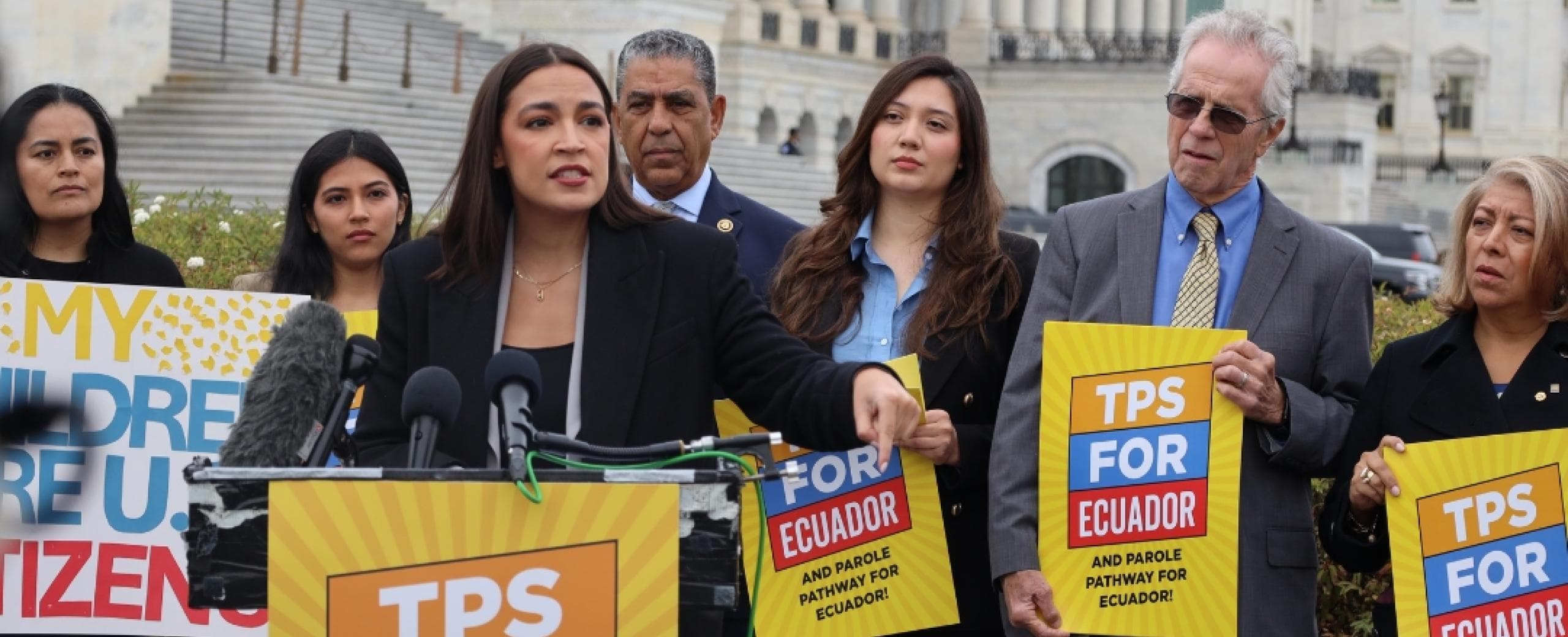
Alexandria Ocasio-Cortez speaks at the Munich Security Conference in February. Sean Gallup/Getty Images.
Nate Silver’s analysis of the emerging Democratic field treats Ocasio-Cortez as a serious prospective contender rather than an inevitable nominee. Her opportunity rests partly on an unusually open progressive lane, while her obstacles include the early state calendar, proportional delegate rules and persistent concerns about national electability. No candidate has yet accumulated enough evidence to turn early speculation into a reliable forecast.
A Clear Progressive Lane Meets a Difficult Calendar
Ocasio-Cortez has several advantages that prospective candidates normally spend years trying to build. She possesses national recognition, an established small donor network and an ideological identity voters already understand. Those assets give her a meaningful political floor, although her ceiling would depend on expanding beyond younger progressives and highly engaged metropolitan voters.
Democrats approved a primary schedule beginning in South Carolina on January 22, 2028, followed by Nevada on February 1. New Hampshire, New Mexico, Michigan and Virginia complete the early window before Super Tuesday. As the Associated Press reported, the order intentionally elevates Black voters, Latino voters and union members early in the nomination process.
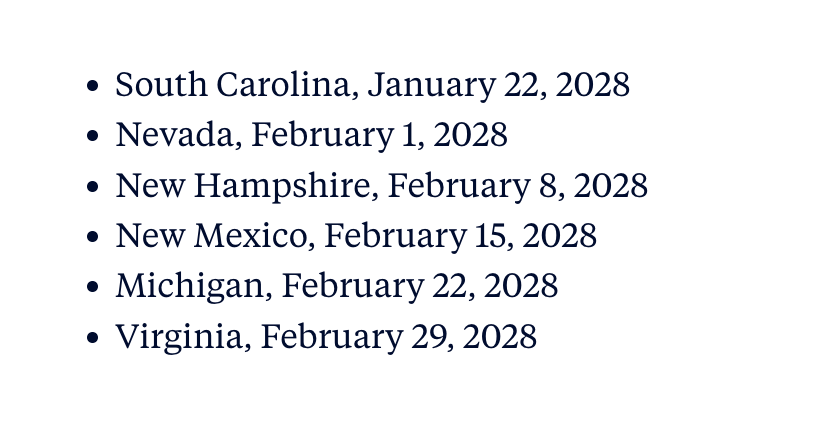
Six diverse states will test coalition strength before Super Tuesday, via Democratic National Committee.
South Carolina presents Ocasio-Cortez with an immediate coalition test. A competitive showing would require durable relationships with Black voters and local party organizations rather than national visibility alone. Gavin Newsom and other possible contenders are already cultivating Southern political relationships, illustrating how the calendar can shape campaign activity years before voting begins.
Nevada could offer Ocasio-Cortez a more favorable combination of Latino voters, organized labor and working-class communities. Michigan may prove even more consequential because of its manufacturing economy, union history and place in the general-election map. Ocasio-Cortez’s support for Abdul El-Sayed’s Senate campaign gives her an opportunity to test whether progressive economic politics can travel beyond safely Democratic constituencies.
Her choices may also be affected by New York. Ocasio-Cortez has left open the possibility of seeking the presidency or challenging Senator Chuck Schumer when his seat is next on the ballot in 2028, according to Axios reporting. Pursuing either office would demand different coalitions, resources and measures of political risk.
Delegate Rules Favor Durable Coalitions Over Early Surges
Democratic nomination rules make an early breakthrough valuable but rarely decisive. Candidates generally must receive at least 15% of the vote statewide or within a qualifying district to earn delegates, after which delegates are distributed proportionally. Unlike systems offering large winner bonuses, that arrangement allows several viable candidates to remain competitive across multiple contests.
Ballotpedia’s review of the adopted allocation framework confirms that the party retained proportional rules based on the system used in 2024. Candidates finishing below the threshold receive no delegates from the relevant jurisdiction. Repeatedly clearing that threshold across different regions therefore matters more than producing one dramatic early victory.
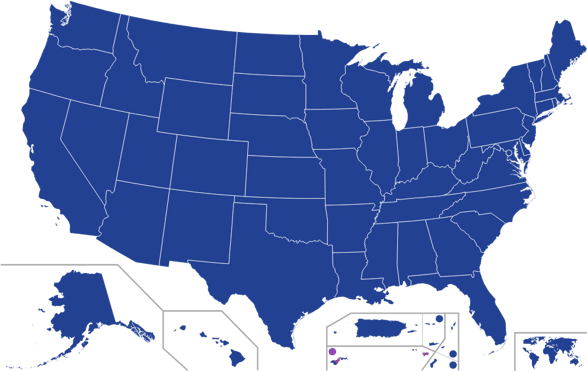
Delegate allocation varied across contests despite a single proportional framework, via Wikimedia Commons.
Such rules could protect Ocasio-Cortez from an early elimination if she maintains a committed national base. They could also limit her ability to convert a Nevada or Michigan victory into an overwhelming delegate advantage. A divided field featuring a progressive candidate, a moderate governor and an ideologically intermediate contender could remain unsettled well beyond the opening states.

Jon Ossoff could occupy that intermediate position if he pursues the nomination. His potential appeal comes from combining generational change with a less ideologically defined national profile. Newsom, Josh Shapiro, Andy Beshear and other governors could make competing arguments based on executive experience, general election performance or coalition building.
Progressive influence should not be measured only by the number of possible presidential candidates. Sanders remains the movement’s most important national mentor, but his age makes another presidential campaign improbable. Mamdani cannot seek the presidency because the Constitution requires a president to be a natural born citizen, while El-Sayed would need to establish himself in federal office before a presidential bid became more than speculation.
Midterm Results Will Shape the Electability Argument
Results from the 2026 elections will influence how Democratic voters interpret the progressive movement’s strength. Ocasio-Cortez has presented El-Sayed’s Michigan campaign as a test of whether the movement can win a presidential battleground. A victory would strengthen progressive claims that economic populism can compete outside deep blue districts, although the margin and surrounding national environment would still matter.
A narrow victory during a favorable Democratic year would not prove that every progressive candidate can reproduce the result nationally. A clear win supported by union households, younger voters and working-class communities would provide stronger evidence. Campaign strategists should distinguish between movement enthusiasm and transferable electoral performance when evaluating either outcome.
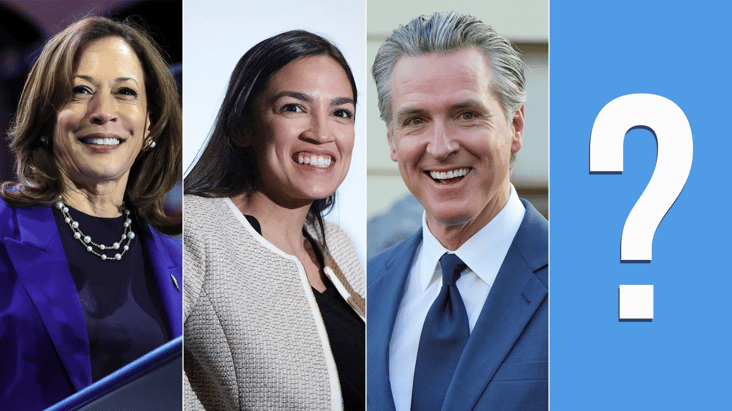
Democrats face competing arguments about ideology, experience and electability nationwide, via Axios.
Ocasio-Cortez’s potential candidacy would also confront concerns about whether Democrats should nominate another woman after the party’s defeats in 2016 and 2024. Those results do not prove that women face an inherent general election penalty. Primary voters’ perceptions can nevertheless influence candidate evaluation even when the underlying assumption is weak or unsupported.
Campaigns evaluating the field should avoid treating a single Senate result as a universal verdict on ideology. Candidate quality, state conditions, national sentiment and opponent weaknesses all affect outcomes. Useful analysis will compare progressive performance with the broader Democratic environment instead of relying only on whether a candidate wins or loses.
Artificial Intelligence Could Reorder Democratic Ideology
Artificial intelligence may become one of the clearest policy dividing lines in the 2028 field. Ocasio-Cortez and Sanders introduced legislation seeking a temporary federal moratorium on new artificial intelligence data centers until Congress establishes safeguards covering workers, consumers, energy systems and local communities. Ocasio-Cortez therefore enters the discussion with a defined position rather than a general promise to regulate emerging technology.
Supporters can frame that proposal around electricity prices, water consumption, employment disruption and corporate accountability. Opponents can argue that an expansive moratorium would slow investment and weaken the United States in its technological competition with China. Both messages translate an abstract technology debate into household costs, employment security and national power.
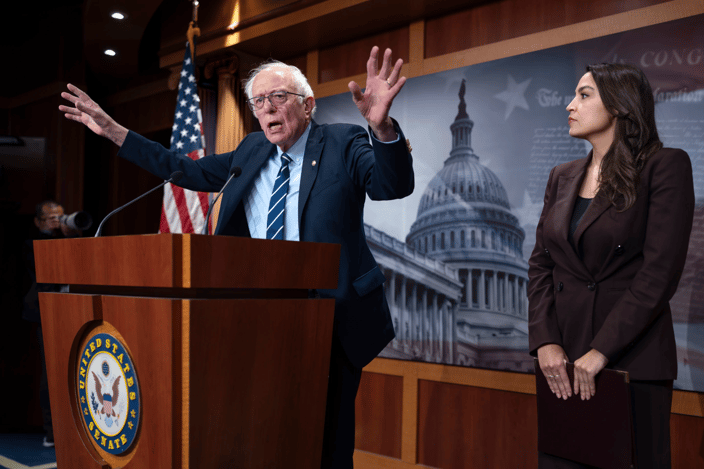
Progressive lawmakers connect artificial intelligence growth with community protections nationwide, via Associated Press.
Newsom and other potential candidates may adopt a different balance between technology development and regulation. Relationships with Silicon Valley, state experience and positions on data center construction could become meaningful primary contrasts. Candidates unable to explain who benefits, who pays and who bears the risk will leave an important voter concern unanswered.
Artificial intelligence also complicates the traditional moderation debate. A candidate may support aggressive technology regulation while taking more conventional positions on foreign policy, public safety or fiscal policy. Campaigns should evaluate issue combinations rather than assuming every contender fits neatly within one ideological category.
Wrap Up
Ocasio-Cortez has a credible opportunity to become the leading progressive voice in the 2028 Democratic contest. That position does not make her the presumptive nominee or confirm that she will run. Her immediate task is demonstrating that her political coalition can expand across racial, regional and economic lines.
Early state results will test different parts of that coalition. South Carolina will measure relationships with Black voters, Nevada will test Latino and labor support, and Michigan will examine the reach of progressive economics in a presidential battleground. Proportional delegate rules will then reward candidates who repeat that performance instead of relying on one breakthrough.
Campaign professionals should watch organization, endorsements, coalition breadth and down-ballot performance more closely than early speculation. Ocasio-Cortez’s influence may ultimately be expressed through a presidential campaign, a Senate race or the policies adopted by other candidates. Either way, the progressive left has secured a meaningful role in defining the choices Democrats will confront in 2028.