


New battleground polling shows Democrats gaining ground in the districts most likely to decide control of the House.
What to Know
- Democrats lead Republicans 50% to 44% in competitive House districts surveyed by the Cook Political Report.
- The battleground districts in the survey were carried by Donald Trump by an average of roughly two points in 2024.
- Independent voters are breaking heavily toward Democrats in many suburban battlegrounds.
- Republicans still benefit from aggressive redistricting and a shrinking number of competitive House seats nationwide.
- The narrow House map means even small turnout swings could determine control of Congress in 2026.
The newest battleground polling from the Cook Political Report delivered one of the clearest warning signs yet for House Republicans heading into the 2026 midterms. Across 36 competitive congressional districts rated Toss-Up, Lean Republican, or Lean Democrat, Democrats currently hold a six-point advantage on the generic congressional ballot, leading Republicans 50% to 44%.
That number matters because these are not naturally Democratic districts. Donald Trump carried these same seats by an average of roughly two points during the 2024 presidential election. In practical terms, the polling suggests Democrats are outperforming the party’s recent presidential baseline precisely where they need to. For Republicans defending a razor-thin House majority, that creates immediate pressure.
Why a Small Lead Could Produce Big Consequences
Modern House elections no longer operate on broad national wave dynamics alone. The battlefield has become dramatically compressed. Years of aggressive redistricting and geographic polarization have reduced the number of truly competitive districts across the country.

David Mayhew image via Yale
According to the battleground analysis, only around three dozen House seats remain genuinely competitive nationwide. Political scientists have been warning about this trend for decades. In a foundational 1974 study, David Mayhew described “the Case of the Vanishing Marginals,” arguing that true swing districts were rapidly disappearing from American politics.
That trend has only accelerated in the modern era. Modern redistricting is no longer simply defensive politics. It has become structural warfare. As Brookings Institution scholars later summarized, the goal of partisan mapmakers is often to create “design wombs for your team and tombs for the other guys.” The result is a congressional map where most seats are effectively insulated before campaigns even begin.


Author Steven Hill argued that aggressive redistricting leaves many Americans politically powerless, writing that many votes become “nearly meaningless, almost as if it had been stolen from them.” Columnist Martin Dyckman captured the frustration even more bluntly: “You didn’t choose your legislators. They chose you.” That insulation fundamentally changes how House majorities are won.
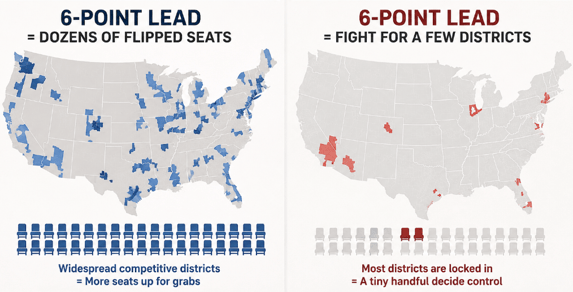
In previous decades, a six-point generic ballot advantage might have translated into dozens of flipped seats nationwide. Today, most districts are structurally locked into predictable partisan outcomes, leaving only a tiny handful capable of deciding control of Congress. Legal scholar Daniel Wodak noted that modern elections now produce a system where “votes in competitive districts are more likely to be decisive, and votes in uncompetitive districts are more likely to be wasted.”

As a result, both parties increasingly concentrate their money, messaging, and turnout operations around a narrow cluster of persuadable voters in states like Arizona, Pennsylvania, Michigan, Virginia, and California.

Ronald Brownstein; image via X
Journalist Ronald Brownstein once described America’s political geography as two parties lining up “with regimented precision, like nineteenth-century armies.” That rigid alignment is exactly why margins now matter so much. The fight for the House is no longer a broad national contest. It is a compressed war fought inside a few suburban counties, a few dozen districts, and among a shrinking pool of persuadable voters who now hold disproportionate power over Congress itself.
Independents Are Sending Republicans a Warning
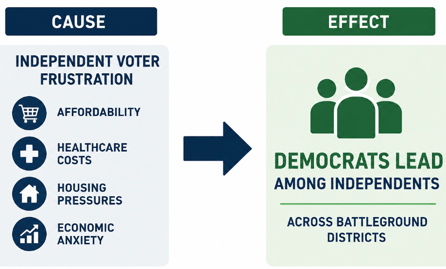
One of the most important findings inside the battleground survey involves independent voters. Democrats currently hold a significant advantage among independents across these districts, fueled largely by frustration over affordability, healthcare costs, housing pressures, and broader economic anxiety.
Fiscal and governance researchers have argued that these economic pressures have transformed into what many now describe as a modern “kitchen table” issue. Peter G. Peterson Foundation CEO Michael A. Peterson recently warned that rising national debt pressures are increasingly felt directly by ordinary Americans through higher consumer costs, grocery prices, and borrowing expenses.

That frustration does not necessarily mean independents are becoming reliable Democratic voters. Many appear politically exhausted, skeptical of both parties, and disengaged from traditional partisan identity altogether. Battleground analysts frequently note that critical swing voters are often made up of people who are not especially enthusiastic about politics itself, reflecting a broader fatigue with constant political conflict and economic instability.
That volatility creates real danger for Republicans in districts where even small shifts among independents can decide control of Congress. Many suburban voters who helped fuel Democratic gains during the Trump era also remain open to Republican candidates focused on economic discipline, public safety, and stability.
Wrap Up
A six-point Democratic advantage in districts that Donald Trump recently carried represents a genuine warning sign for Republicans, particularly in suburban districts where affordability pressures and independent voter frustration continue reshaping the political landscape. But history also suggests caution. Early polling often captures voter mood before partisan loyalties harden, turnout operations intensify, and lower-engagement voters fully re-enter the electorate.
That is what makes the 2026 House fight so volatile. The congressional map is now so compressed, polarized, and structurally engineered that control of Congress may ultimately come down to a tiny cluster of suburban battlegrounds and a narrow band of persuadable independents.
Democrats are betting that suburban fatigue and economic frustration remain powerful enough to overcome Republican structural advantages. Republicans are betting that polarization, turnout mechanics, and late-cycle voter consolidation eventually pull swing voters back toward familiar partisan patterns. In a battlefield this narrow, even microscopic shifts could decide control of the House.


-3.png)