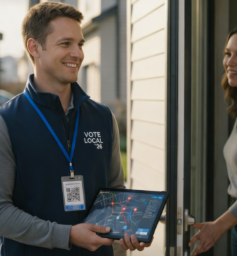

Campaign field programs are undergoing a structural shift as digital-first organizing replaces traditional door knocking, reshaping how turnout is built and persuasion is attempted ahead of 2026.
What to Know
- Campaigns are rapidly scaling digital-first field operations over in-person canvassing.
- Texting, relational organizing apps, and virtual phone banks now reach voters at lower cost.
- Digital field is proving stronger for turnout than persuasion.
- Door knocking remains effective but increasingly limited by cost and labor constraints.
- The shift is redefining what a “ground game” looks like heading into 2026.
Door knocking was once the gold standard for robust campaign operations. While it was inherently slow, expensive, and difficult to expand, its perceived authenticity made it the go-to method for meaningful voter engagement. Campaigns demonstrated their dedication through canvassing programs and assessed their field strength based on the volume and frequency of doors they managed to reach.
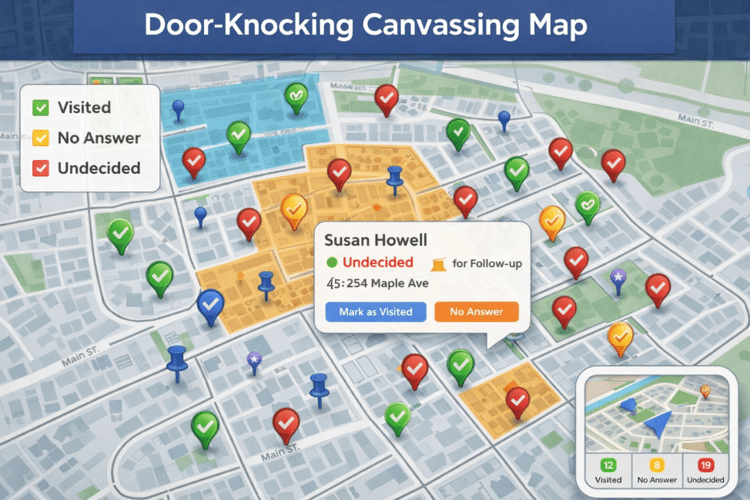
That model is now breaking down. Across parties, digital-first field operations are displacing traditional canvassing as the core engine of voter outreach. Campaigns are leaning into peer-to-peer texting, online volunteer mobilization, and algorithmic targeting, prioritizing reach and efficiency over face-to-face interaction. What began as a pandemic workaround has hardened into a structural shift, with many campaigns now treating digital field not as a supplement, but as the primary mechanism for turning out and persuading voters.
Why Campaigns Are Moving Digital
The shift toward digital-first field operations is, at its core, a resource calculation. Traditional door knocking demands layers of fixed costs: paid organizers, turf cutting, transportation, training, compliance monitoring, and ongoing volunteer management. Digital programs compress those costs. A small staff can deploy large-scale outreach quickly, adjust messaging in real time, and expand or contract operations without rebuilding infrastructure from scratch.
Efficiency compounds that advantage. A single organizer can oversee thousands of voter contacts per day through peer-to-peer texting or relational organizing platforms, driving the cost per contact down to a fraction of in-person canvassing. At the same time, campaigns face a tightening labor market. Sustaining door-knocking programs over months is increasingly difficult, particularly in midterms. Digital field lowers participation barriers, allowing volunteers to engage from home in short, flexible windows, dramatically expanding the usable volunteer pool.
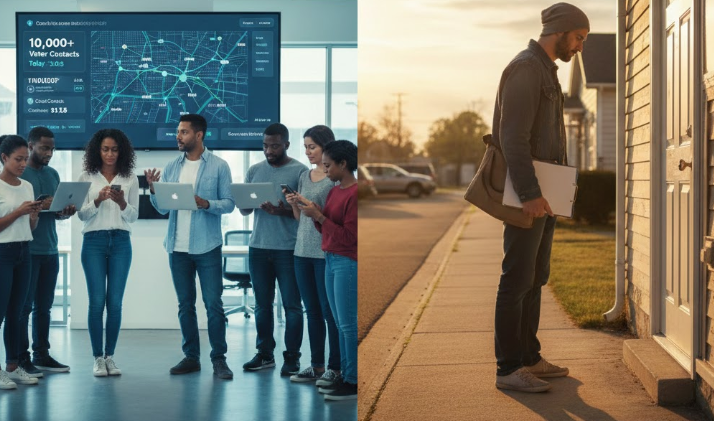
Voter behavior completes the shift. More voters live in secured buildings, work irregular hours, or simply do not answer the door. Phones, by contrast, remain a constant point of contact. Digital outreach aligns campaign strategy with how voters actually live, replacing physical access with persistent, scalable presence.
How the Pandemic Prototype Became the 2026 Playbook
If you want a clean origin story for the digital-first ground game, it starts on college campuses in 2020. Denison University senior Matt Nowling, then interim president of College Democrats of America, described the old model as literal “dorm storming” to register voters, running door-to-door through residence halls.

That muscle memory broke overnight. Ben Rajadurai, executive director of the College Republican National Committee, captured the pivot with one line: organizers were trained to “knock doors, not keyboards,” and suddenly they had to do the opposite.

Meanwhile, Claire Grissum, leading College Republicans at the University of Missouri, described the always-on GroupMe and social media organizing that replaced tabling and sidewalk conversations, with the key downside: it is harder to grab the attention of students who are not already looking for politics.

That campus shift mattered because it created a working prototype for what campaigns later operationalized at scale: distributed volunteer contact, lightweight time commitments, and platform-based registration and mobilization. NPR’s reporting also highlighted how the broader ecosystem started leaning in, including Snapchat adding in-app voter registration and Facebook pledging to register millions of voters, effectively pulling “field” into the same attention channels campaigns already used for persuasion and fundraising.
Fast forward, and what began as a crisis workaround has been productized into formal national infrastructure. The clearest example is the Democratic Congressional Campaign Committee (DCCC), chaired by Rep. Suzan DelBene, launching P.O.W.E.R. The People as an “eight-figure” investment explicitly built to persuade and mobilize voters through research, paid media across channels, in-district organizing, voter protection, and active countering of online misinformation.

Importantly, the program is designed around where people actually consume information, including media-consumption research and shareable content hubs, which is digital-first field thinking in institutional form.
The Digital Organizing Toolkit
Modern field programs are now built around a stack of tools that barely existed a decade ago. Peer-to-peer texting platforms allow campaigns to send individualized messages at scale while remaining compliant with automated messaging laws. Relational organizing apps transform supporters’ personal networks into outreach channels, extending campaign reach far beyond traditional lists. Virtual phone banks operate continuously across time zones, untethered from physical offices or scheduled shifts.
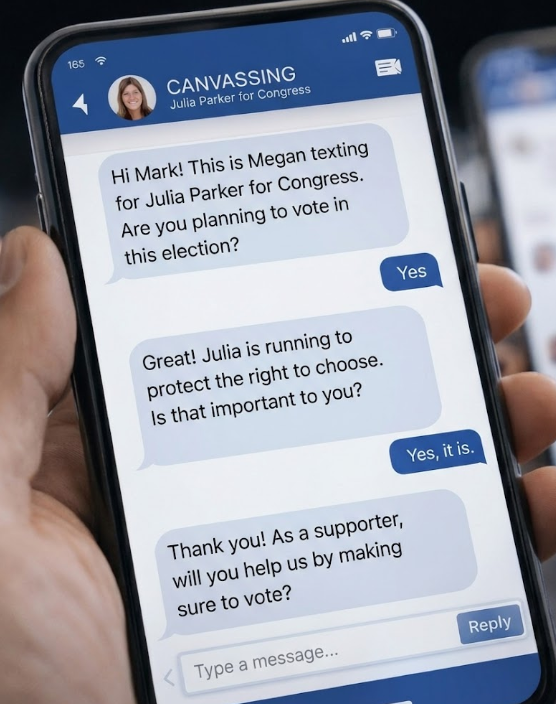
What makes these tools powerful is integration. Digital field platforms plug directly into voter files, enabling precise targeting, rapid experimentation, and real-time feedback. Campaigns can adjust scripts mid-day, identify which messages are landing, and reallocate staff or volunteers almost instantly. Field operations that once required weeks of planning can now pivot in hours.
Digital organizing also collapses the wall between field, fundraising, and advertising. A voter contacted by text can be retargeted with an ad, receive a donation ask, and be reminded to vote, all within the same ecosystem and without ever opening a door. From an operational perspective, the system is cohesive, measurable, and scalable, advantages that traditional canvassing struggles to match.
Turnout Versus Persuasion
The central tradeoff in the shift away from door knocking is not ideology but effectiveness. Digital field operations are exceptionally strong at turnout and comparatively weaker at persuasion. Text reminders, ballot-chase programs, and early-vote nudges consistently perform well when voters are already aligned. These tactics excel at base mobilization, ballot curing, and last-mile GOTV, where speed and repetition matter more than depth of engagement.
Persuasion operates under different rules. Face-to-face contact remains the most reliable way to change minds, particularly among low-information, skeptical, or disengaged voters. Digital messages are easier to ignore, delete, or misunderstand, and they struggle to replicate the trust built through in-person interaction. Campaigns are increasingly aware of this limitation, but many have chosen to accept it. The electorate is highly polarized, true persuasion universes are shrinking, and most competitive races are now decided by who turns out rather than who switches sides.
In that context, digital-first field aligns with modern campaign math. It prioritizes scale, speed, and efficiency over depth, trading some persuasive power for a broader ability to mobilize voters who are already inclined to participate.
What Campaigns Gain and Lose
The gains from digital-first field operations are significant. Scale is the most immediate advantage. Digital outreach allows campaigns to reach voters that traditional canvassing often cannot, including rural communities, gated developments, and highly mobile populations. Speed follows closely.
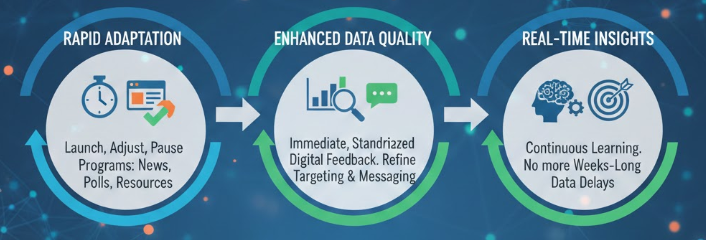
Programs can be launched, adjusted, or paused almost instantly in response to breaking news, polling shifts, or changes in resources. Data quality also improves. Digital interactions generate immediate, standardized feedback, enabling campaigns to refine targeting and messaging continuously rather than waiting days or weeks for canvass data to be processed. Just as important, digital-first field reduces burnout. Volunteers can participate on flexible schedules from home, making long-term engagement more sustainable over extended campaign cycles.
What campaigns lose is equally important. Digital field lacks the human friction that forces engagement. A door knock creates a moment of interaction that a text message does not, and that difference matters when building trust or explaining complex issues. Digital programs also increase the risk of message fatigue.
Voters are inundated with texts from campaigns, advocacy groups, and PACs, making it harder for any single message to stand out. There is also a representational gap. Digital outreach tends to overreach younger and more connected voters while underreaching older or less tech-savvy populations unless it is paired with traditional methods. Campaigns that move fully digital risk missing voters who still expect personal contact.
Wrap Up
By 2026, door knocking will not disappear, but its role will narrow. In-person canvassing will increasingly be reserved for high-value persuasion universes, special elections, and close local races where personal contact still moves opinions. At the same time, digital-first field will dominate statewide and federal campaigns, particularly in large or geographically dispersed districts where scale matters more than intimacy.
The most effective campaigns will not frame this as a choice between digital and traditional field. They will integrate both deliberately, using digital tools to drive scale and turnout while deploying door knocking selectively for persuasion and credibility. Campaigns that cling exclusively to door knocking risk inefficiency and burnout. Campaigns that abandon it entirely risk shallow engagement and missed voters.
The decline of door knocking is about adaptation. Digital-first field operations offer speed, reach, and cost efficiency that traditional canvassing cannot match. But efficiency comes with tradeoffs. As organizing becomes more virtual, campaigns gain reach and lose depth. Heading into 2026, the winning ground games will be those that understand this balance and apply each tool where it actually moves votes.