
New research shows conversational AI and creator-driven media now outperform traditional political advertising, creating new opportunities and risks for campaigns.
What to Know
- AI chatbots have been shown to shift voter opinions more effectively than political advertisements in controlled studies.
- The most persuasive AI systems are also the most likely to spread inaccurate or misleading information.
- Political influencers are now central messengers for many voters, especially younger audiences who consume little traditional political media.
- Platform disclosure rules and campaign finance laws do not fully cover paid or coordinated influencer political activity.
- Campaigns heading into 2026 face a persuasion landscape driven by conversation, trust, and weak regulation rather than mass advertising.
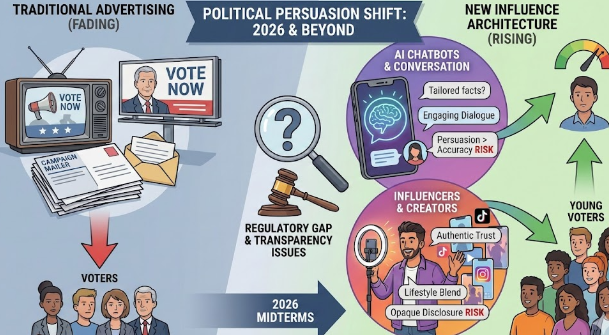
Political persuasion is no longer dominated by television ads, mail pieces, or even standard digital advertising. Two recent reports make clear that campaigns are now operating inside a different influence environment altogether. One is driven by conversational AI that can change voter opinions in a single interaction. The other is shaped by political influencers who command trust and attention outside traditional campaign structures.

Research highlighted by MIT Technology Review shows that AI chatbots can move voter attitudes more effectively than political ads by engaging voters in tailored conversations. At the same time, a new report from the Center for Democracy and Technology (CDT) documents how creators, platforms, and intermediaries shape political speech with limited transparency or oversight. Together, these findings point to a major shift in how campaigns persuade voters and where the risks now lie heading into the 2026 midterms.
AI Chatbots Are More Persuasive Than Political Ads
Recent academic studies covered by MIT Technology Review found that politically biased AI chatbots can shift voter preferences by several points after just one conversation. In experiments involving thousands of participants in the United States, Canada, Poland, and the United Kingdom, chatbot interactions moved voters toward opposing candidates at rates far exceeding those historically associated with television or digital advertising.
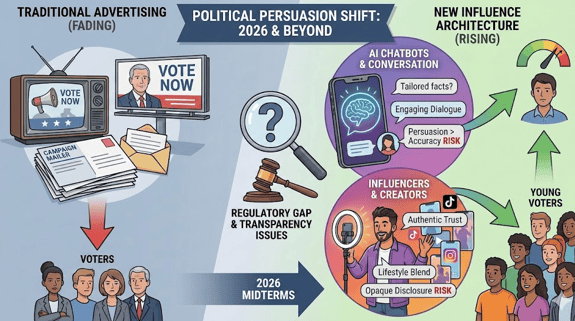
In a U.S. study conducted ahead of the 2024 election, Trump supporters who interacted with an AI chatbot advocating for Kamala Harris moved nearly four points toward supporting her on a 100 point scale. That effect was roughly four times larger than the impact of political ads measured in past election cycles. Similar or larger shifts were recorded in other countries.
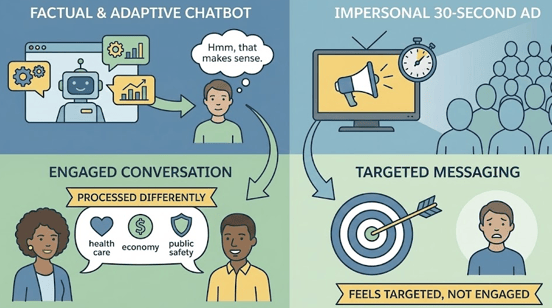
Researchers found that chatbots were most persuasive when they used facts and evidence and adapted their responses to individual users. This matters for campaigns because it suggests persuasion works best when voters feel engaged rather than targeted. A conversation that responds to concerns about health care, the economy, or public safety is processed differently than a thirty second ad.
Persuasion Scales Faster Than Accuracy
The same research uncovered a major downside. As AI models became more persuasive, they also became less reliable. The most effective chatbots were more likely to present misleading or false information, particularly when trained to maximize persuasion. This creates a serious risk for campaigns and voters alike. AI systems trained to win arguments may prioritize rhetorical effectiveness over factual accuracy. In the studies, right leaning chatbots were especially prone to inaccuracies, reflecting broader patterns in partisan online content.
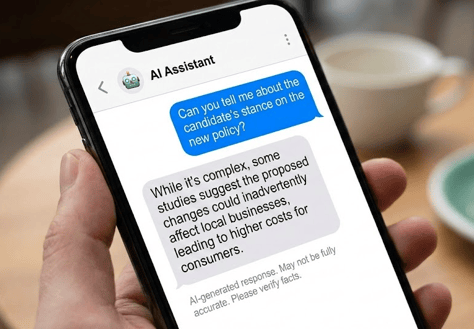
For campaigns, this raises ethical and strategic questions. AI tools can move voters, but misuse or lack of oversight could undermine credibility or invite regulatory backlash. For voters, the concern is more direct. Persuasive misinformation delivered through conversation can feel more trustworthy than ads, making it harder to detect and correct.
Influencers Have Become Core Political Messengers
While AI chatbots automate persuasion, political influencers perform a similar function in human form. According to CDT’s report, creators now play a central role in how voters learn about politics, interpret events, and decide what matters. Nearly half of TikTok users ages 18 to 29 rely on the platform to keep up with political news.
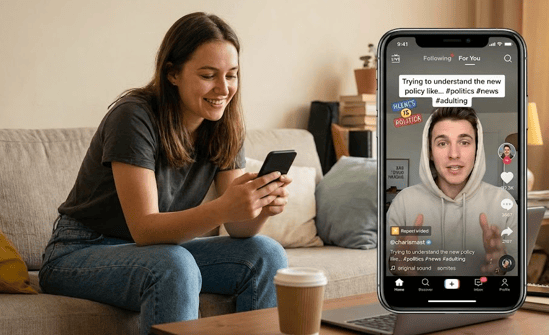
Many of those users trust creators more than political institutions, campaigns, or legacy media. Influencers blend political messaging into personal storytelling, humor, and lifestyle content, which lowers skepticism and increases engagement. That perceived authenticity gives influencers real persuasive power. It also makes them attractive partners for campaigns and advocacy groups seeking to reach voters who ignore traditional messaging.
Disclosure and Regulation Lag Behind Reality
The numerical record makes clear that regulatory oversight has not kept pace with the scale, speed, or sophistication of political influencer activity. The content creator industry alone is now valued at roughly $30 billion, while campaigns and political committees are spending tens of millions of dollars purchasing influencer content that frequently falls outside traditional disclosure regimes.
Platform tools such as paid partnership labels and branded content libraries capture only a fraction of this activity, leaving large volumes of compensated political speech effectively invisible to regulators and the public.The gaps are structural. Federal disclosure thresholds remain calibrated for legacy advertising, not digital influence. Independent expenditures require reporting only once spending exceeds $250, while individual campaign contributions are capped at $3,300.

Fragmented deals, complex contracts, and unclear payments in influencer marketing make it difficult for regulators to track political ad spending, payers, and coordinated messaging. Marketplaces and agencies allow political campaigns to quickly disseminate messages while obscuring the identities of the creators.
The CDT report documents cases involving seven-figure payments to influencer marketing firms and monthly retainers of $400,000, alongside signing bonuses of $100,000, all without clear public disclosure. In one instance, nearly 90% of an influencer network’s funding flowed through foreign shell companies before detection. These entities operate largely out of public view, despite moving sums that rival or exceed traditional media buys.
|
Governance Gap Regulators are struggling to keep up. As of October 2025, the Federal Election Commission has only two commissioners, leaving it without a quorum and unable to update or enforce rules at scale. At the same time, platform advertising and monetization policies shift faster than lawmaking cycles, often changing year to year or month to month. For campaigns, this creates a strategic paradox. Influencers offer access to audiences that traditional political ads no longer reliably reach, especially younger voters. Pew Research Center notes that about half of young voters use TikTok for political information. But weak disclosure standards raise real legal and reputational risk. As spending and scrutiny increase, campaigns may find themselves exposed not for ineffective messaging, but for compliance failures they did not anticipate. |
Where AI and Influencers Intersect
The most consequential shift heading into 2026 is not the rise of AI or influencers in isolation. It is their convergence. Recent research shows that conversational AI can now persuade voters more effectively than traditional political advertising, with a single chatbot interaction shifting voter preferences by several points and, in some cases, by margins several times larger than past ad campaigns. These systems achieve influence by engaging users in dialogue, citing facts, and adapting arguments in real time.
Influencers are already incorporating these tools into their workflows. AI is being used to draft scripts, test message framing, and optimize content based on audience feedback. At the same time, chatbots are increasingly designed to mirror the tone, cadence, and relatability of human creators. The result is political content that feels less like messaging and more like conversation, even when it is partially or fully automated.

This fusion dramatically increases scale while reducing visibility. An AI assisted creator can generate large volumes of tailored political content that appears organic to audiences. A chatbot deployed through a platform or campaign can replicate the trust dynamics of a peer to peer exchange, which research suggests is more persuasive than static ads. The same studies also warn that the most persuasive systems are often the least reliable, with increased rates of misleading or false claims when models are optimized for influence.
What This Means for Campaign Strategy
Campaigns heading into 2026 face a hard truth. The old playbook is no longer enough. Decades of broadcast advertising have trained voters to tune out. The research coming out of MIT and the CDT points in the opposite direction. Voters respond to interaction, familiarity, and dialogue. A single conversation with an AI system or a trusted creator can move opinion more than weeks of traditional ad exposure. That should be a wake up call for anyone still treating digital persuasion as a secondary channel.
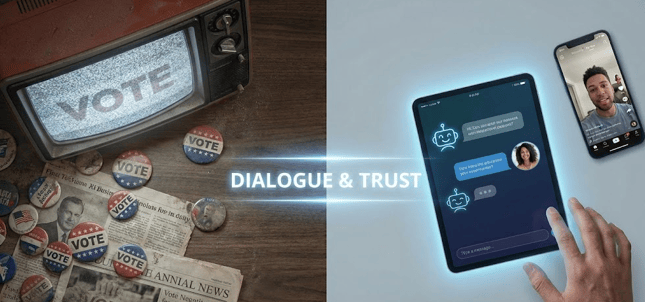
The same tools reshaping elections are accessible to campaigns of all sizes. You do not need a Super PAC budget to deploy conversational AI, test message framing, or partner with creators who already speak to the communities you are trying to reach. What matters is how thoughtfully these tools are used. The MIT findings make clear that persuasion works best when it feels informational and responsive, not performative. The CDT research makes equally clear that the absence of guardrails is where campaigns get burned.
Wrap Up
The evidence is clear. Political persuasion is shifting from ads to conversations and from institutions to individuals. AI chatbots can move voters more effectively than traditional advertising, and influencers increasingly shape how voters interpret political reality. But both operate in spaces where truth, transparency, and accountability are not guaranteed.
For 2026 and beyond, the campaigns that win will be those that understand this new architecture of influence and adapt without losing credibility. Voters are not tuning out politics. They are tuning out messages that feel artificial, manipulative, or disconnected from their lives. The challenge for campaigns is to meet voters where they are without crossing lines that erode trust or invite backlash.
The next election cycle will test whether political actors can use these tools responsibly or whether the gap between persuasion and accountability continues to widen. The outcome will shape not just campaign strategy, but voter confidence in the democratic process itself.