

Republicans are testing a new national message focused on cost-of-living pressure as they attempt to compete on economic terrain long dominated by Democrats.
What to Know
- Republicans have launched a nationwide “Affordability Tour” centered on housing, childcare, healthcare, and everyday expenses.
- The messaging prioritizes prices, debt, and household stress over traditional tax-cut or deregulation frameworks.
- Early voter response suggests the approach is resonating with working-class voters and independents.
- The strategy reflects a recognition that voters experience the economy through monthly bills, not macroeconomic indicators.
- Affordability is emerging as a central battleground heading into the 2026 cycle.
For years, Republicans struggled to speak credibly about cost-of-living pressures without defaulting to tax cuts, inflation metrics, or culture war framing. That approach increasingly failed to match how voters experience economic stress. Rising rents, childcare costs, insurance premiums, and grocery bills reshaped the political conversation, and Republican strategists appear to have taken notice.
The GOP’s “Affordability Tour” as discussed by Forbes represents a coordinated effort to reposition the party around those lived realities. Rather than treating housing or healthcare as secondary issues, Republican candidates are elevating them to the center of their economic messaging. The goal is not to debate economic theory, but to acknowledge the daily tradeoffs families face and present Republicans as engaged with those pressures rather than dismissive of them.
What the ‘Affordability Tour’ Looks Like on the Ground
The tour consists of town halls, media events, and policy rollouts in battleground states, with a particular focus on suburbs and exurbs where cost pressures have intensified fastest. Candidates talk about rent increases, unaffordable childcare, rising medical bills, and debt that continues to grow even as inflation slows.
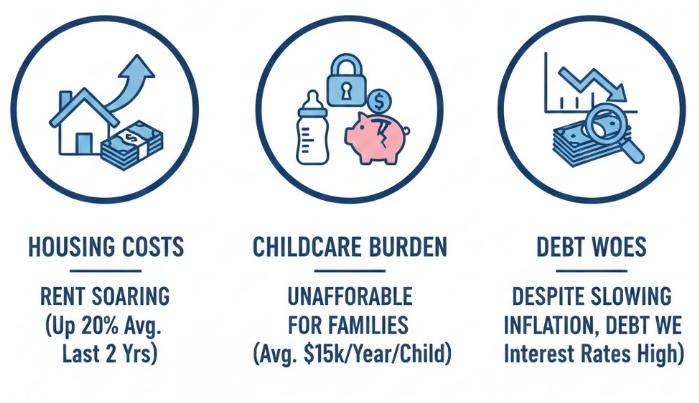
The underlying logic is straightforward. Voters do not judge the economy by GDP growth or unemployment rates. They judge it by whether their paycheck stretches far enough to cover essentials. Republican leaders increasingly view affordability as the connective tissue between economic frustration and political volatility. The tour is designed to make those frustrations visible and translate them into a national argument about governance and accountability.
Why Affordability Became the Dominant Frame
Affordability did not gradually drift into political prominence. It snapped into place. Democrats were first to consolidate it as a catch-all frame, recognizing that voters rarely separate housing, food, healthcare, and utilities into discrete policy silos. They experience them as a single financial squeeze.
Once that language took hold, it reshaped campaigns and voter expectations. Mentions of “affordability” surged in 2025, and the framing helped Democrats align economic messaging with lived experience. Republicans, by contrast, were slower to adapt. Even when inflation cooled, voter dissatisfaction remained high because monthly expenses did not meaningfully retreat.
Healthcare Affordability and the Perception Gap
Healthcare illustrates the political challenge embedded in affordability messaging. According to a fact sheet released by the Centers for Medicare & Medicaid Services, the average HealthCare.gov premium after tax credits for the lowest-cost plan in 2026 is projected to be $50 per month for eligible enrollees, a $13 increase from 2025 but still below pre-pandemic levels. Tax credits are expected to cover roughly 91% of the lowest-cost plan premium, a higher share than in 2020, and most enrollees will continue to have multiple plan options available.
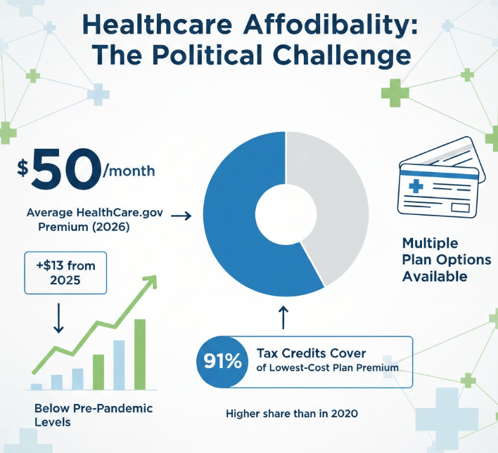
On paper, those figures support the administration’s argument that marketplace coverage remains broadly affordable. In practice, the political impact is more complicated. Premiums may be subsidized, but deductibles, out-of-pocket costs, and related expenses continue to weigh on household budgets, particularly for middle-income families who do not experience affordability through headline averages. Even modest increases register sharply for voters already managing rent, childcare, and debt.
Housing Affordability Remains Near Historic Lows
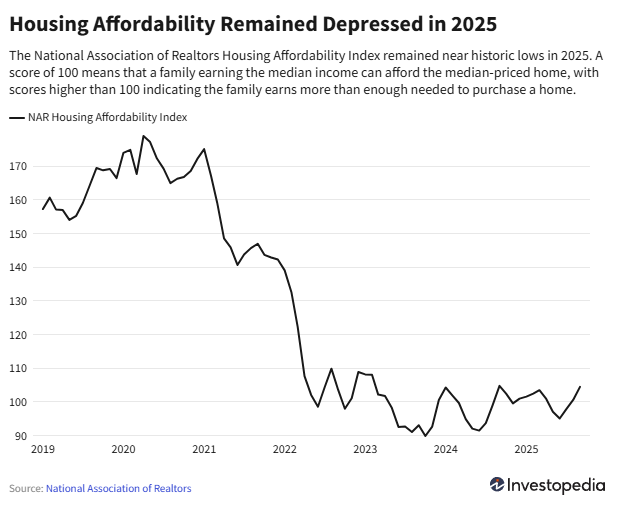
Housing affordability remained near historic lows in 2025, according to the National Association of Realtors Housing Affordability Index, which tracks whether a median-income family can afford a median-priced home. Despite easing inflation, the index shows affordability has not meaningfully rebounded since its sharp decline in 2022, reinforcing why voter dissatisfaction persisted even as headline economic indicators improved.
Donald Trump's launch of his own Affordability Tour, while simultaneously dismissing the importance of affordability rhetoric, highlights the inherent contradiction in the current political landscape. The issue was no longer whether affordability mattered. It was whether Republicans could engage it credibly after years of downplaying it. Voters had already absorbed the frame. The party arriving late faced a credibility test rather than a branding opportunity.
Food Prices Undercut Affordability Claims
Food costs remain another pressure point undermining claims that affordability is improving. According to reporting by the The New York Times, grocery prices continued to rise into early 2026 despite repeated assertions from Donald Trump that food prices were falling. Data from the Bureau of Labor Statistics show food-at-home prices increased 2.4% over the past year, with a sharp 0.7% jump in December alone, the largest single-month increase since October 2022.
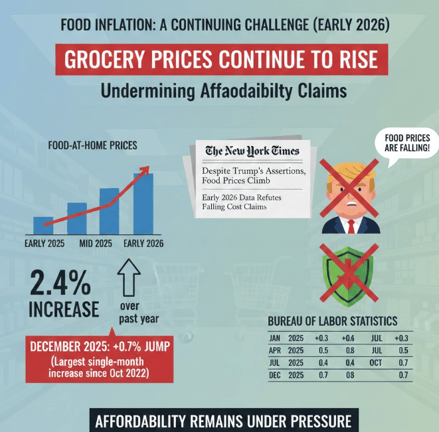
Price increases have been particularly pronounced in staples that anchor household grocery budgets. Beef prices rose more than 16% year over year, coffee nearly 20%, and items like lettuce and frozen fish also posted notable gains. While some products, such as eggs and certain dairy items, declined in price, five of the six major food-at-home categories tracked by federal data increased overall.
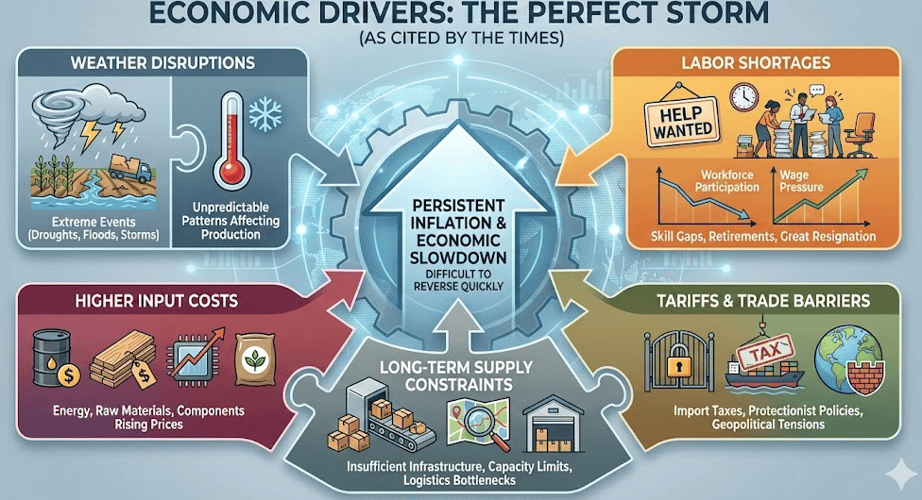
Economists cited by the Times point to a mix of weather disruptions, labor shortages, higher input costs, tariffs, and long-term supply constraints as drivers that are difficult to reverse quickly.
Early Voter Response Signals
Polling suggests affordability is cutting through with voters who feel politically unmoored. Democratic polling shared with POLITICO shows 61% of voters say their lives are less affordable than a year ago. Among voters who supported Biden in 2020 and switched to Trump in 2024, that figure rises to 66%. Only 9% say life is more affordable.
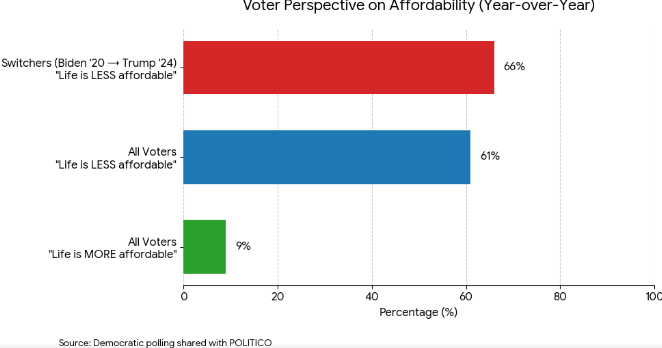
That gap explains why affordability now ranks at or near the top for independents and soft partisans. It also explains why both parties are converging on the issue heading into 2026. Democrats are framing the next cycle as a referendum on costs, particularly healthcare and insurance, while Republicans are attempting to neutralize the issue by engaging it directly rather than ceding it by default.
Inside the GOP, the strategy carries tension. Affordability messaging polls well with younger voters and working-class households under pressure from rent and debt, but it creates friction with parts of the conservative base, particularly around healthcare spending and subsidies. Party leadership appears willing to manage that conflict. The calculation is pragmatic. When most voters feel worse off, refusing to engage on affordability is not a viable strategy, even if it complicates internal coalitions.
Wrap Up
The Affordability Tour is a strategic recalibration, not a guarantee of success. Talking about costs without delivering visible relief carries real risk. Voters who feel promised change without results often disengage or turn more sharply against whoever made the case.
There is also the challenge of execution. Housing, childcare, healthcare, and debt do not move in tandem, and addressing them simultaneously exposes tradeoffs that are difficult to explain cleanly. Democrats are not abandoning this terrain. They are actively positioning affordability as the defining issue of 2026 and will challenge Republicans on credibility, consistency, and past governance.
Affordability is no longer a peripheral message or a supplemental talking point. It has become a trust test. In the coming cycle, voters will be less interested in who talks about costs most effectively and more focused on who demonstrates an ability to lower them in ways that feel real.
-3.png)