


To capitalize on a favorable 2026 Senate map, Republicans are focused on candidate quality and discipline to avoid primary chaos that has recently cost them winnable races.
What to Know
- The National Republican Senatorial Committee is actively discouraging primary challenges against GOP incumbents.
- Republicans face a structurally favorable Senate map in 2026, with Democrats defending more competitive seats.
- Data from recent cycles shows nominees emerging from chaotic primaries underperforming in general elections.
- Party leadership is emphasizing “candidate quality” over ideological signaling.
- The strategy risks backlash from grassroots activists but reflects lessons learned since 2018.
The National Republican Senatorial Committee (NRSC) is not subtle about its message heading into 2026. Republicans have a real shot at expanding or locking down Senate control, and leadership has little patience for internal warfare that could derail that opportunity. After several cycles where flawed nominees turned favorable maps into missed chances, the committee is moving aggressively to shut down what it calls incumbent hunting.

Screenshot from NRSC website
This is not about protecting personalities. It is about math, margins, and memory. Senate control has repeatedly come down to one or two seats. Leadership believes that the difference between winning and losing often has less to do with ideology and more to do with whether a nominee can raise money, stay on message, and survive national scrutiny.
The 2026 Senate Map and Why It Matters
The starting point is the map. In 2026, Democrats are expected to defend more seats than Republicans, including several in states that have leaned Republican at the presidential level in recent cycles. That imbalance alone creates opportunity.
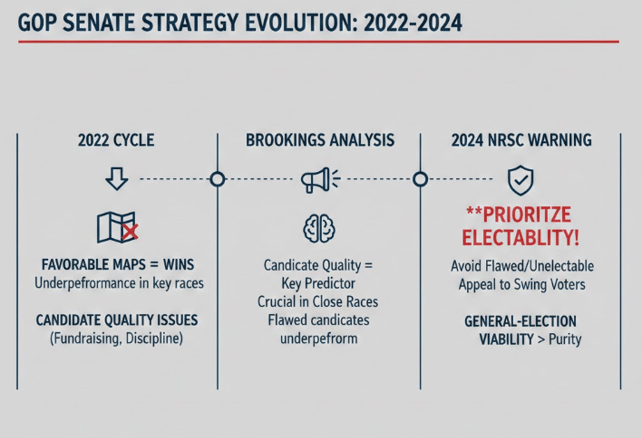
History shows that favorable maps do not guarantee favorable outcomes. In 2022, Republicans entered the cycle with expectations of a clear Senate pickup. Instead, they fell short in multiple races that polling and fundamentals suggested were winnable. Candidate-specific factors played a decisive role.
According to analysis from the Brookings Institution, candidate quality has become increasingly predictive of Senate outcomes, particularly in close races. Nominees who struggled with fundraising, discipline, or basic campaign execution consistently underperformed partisan baselines.
The NRSC warns that the GOP's advantage in retaking the Senate majority is not guaranteed. Their core message is clear: nominating a flawed, unelectable, or deeply controversial candidate is the certain route to losing a winnable seat. The NRSC urges prioritizing electability and general-election viability over ideological purity, as a candidate who cannot appeal to swing voters will fail.
Reasserting Institutional Control
The shift in Republican primary management is not accidental. Under Chairman Steve Daines, the NRSC moved away from the largely hands-off posture of the 2022 cycle and toward active intervention. The premise is straightforward. Senate races are too expensive, too nationalized, and too structurally unforgiving to be left to intraparty trial and error.

Senator Steve Daines; image via website
Daines has framed the mission around “candidate quality,” but in practice that term is operational rather than ideological. Quality means fundable, disciplined, and survivable under national scrutiny. It means avoiding nominees who emerge damaged from primaries or who lack the infrastructure to compete in a general election environment dominated by outside spending.
This approach reflects lessons drawn from recent failures. In cycles where the party allowed crowded or ideologically driven primaries to unfold organically, Republicans often entered general elections weakened or uncompetitive. The Daines-led NRSC has responded by asserting itself earlier in the process, shaping fields before they metastasize into liabilities. Primaries are no longer treated as neutral contests. They are treated as risk vectors to be managed.
Primary Chaos: The Price Tag
Primary fights are expensive, both financially and politically. Competitive primaries can drain millions of dollars that would otherwise be spent defining Democratic opponents. They also force candidates to take positions tailored to base voters that can later alienate independents. Data from recent cycles shows that nominees emerging from bruising primaries often enter the general election with lower favorability ratings and higher negative name recognition.
|
What is an Incumbent? An incumbent is the person already holding the seat. In a Senate race, that usually means someone who has won statewide, built donor relationships, and has a record voters can recognize. Incumbents come with built-in advantages, which is why parties usually defend them. Lately, that norm has broken down. Some Republican incumbents are being targeted by their own base. Activists see primaries as a way to punish senators they view as weak, quiet, or insufficiently aggressive. These challenges are framed as accountability. In practice, they are expressions of frustration. From the NRSC’s view, this kind of incumbent hunting is dangerous. Primaries drain money, create damaging headlines, and expose vulnerabilities that Democrats later exploit. Even incumbents who survive can limp into the general election weakened. With Senate control often decided by a handful of races, party leaders are moving to shut down these fights early. The goal is not to protect egos. It is to avoid losing winnable seats to self-inflicted damage. |
How the NRSC Cleared the Field
The change in strategy is visible in specific races where the NRSC moved decisively to protect preferred candidates and discourage challengers.
In West Virginia, the committee quickly consolidated around Governor Jim Justice, signaling that Congressman Alex Mooney, despite conservative support, would not receive institutional backing. By releasing polling that framed Justice as the only viable general election candidate and withholding national resources from Mooney, the NRSC effectively settled the race long before primary voters engaged.

Governor Jim Justice (left) and Representative Alex Mooney (right)
In Montana, the intervention was even more explicit. The NRSC recruited Tim Sheehy to challenge Jon Tester and made clear that it viewed Matt Rosendale’s entry as a threat to the party’s chances. Within days of Rosendale filing, institutional opposition hardened. Donor signals dried up. Public messaging aligned against him. Facing overwhelming pressure and no path to support, Rosendale exited the race within a week.

Representative Tim Sheehy (left), Representative Jon Tester (middle), Representative Matt Rosendale (right).
In Pennsylvania, the committee acted preemptively. After a bruising primary in the previous cycle, the NRSC moved with unusual speed to endorse Dave McCormick early. That endorsement functioned less as an expression of support and more as a deterrent. Potential challengers were effectively frozen out before a competitive field could form, preventing another costly intraparty fight.

Representative Dave McCormick
Across these races, the tactics were consistent. Early endorsements. Strategic polling releases. Funding signals that communicated viability or the lack of it. The objective was not persuasion. It was consolidation.
Institutional Control Versus Grassroots Energy
This approach creates real tension inside the party. Grassroots activists often see primaries as a way to hold incumbents accountable and push candidates who better reflect the base. From their perspective, challenging sitting senators is not chaos but a necessary correction when leaders seem complacent or out of step.
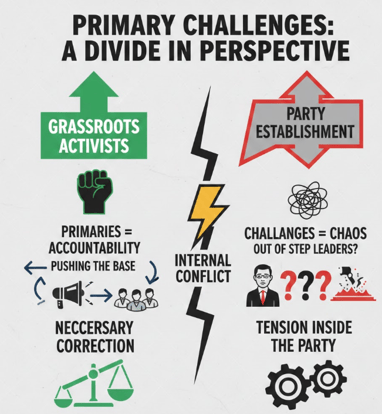
Party leadership is making a different case. They are arguing that winning matters more than venting frustration. Control of the Senate means judges get confirmed, committees are chaired, and legislation moves. Losing the chamber turns ideological wins into empty gestures. After several cycles of costly primary fights, party institutions are stepping back in to shape candidate pipelines, especially in Senate races where the margin for error is thin.
What “Candidate Quality” Actually Means
When party strategists talk about "candidate quality," they aren't necessarily referring to a candidate's moderate ideology. Instead, the term has a practical meaning: a quality candidate is one who can run a proficient, trouble-free campaign that doesn't become a liability for the party.
This definition encompasses several key elements, starting with fundraising. A quality candidate must be able to raise sufficient money to remain competitive through Election Day. Furthermore, they need to avoid unforced errors that generate negative press and distractions. Crucially, they must also be capable of managing national media scrutiny without making statements or taking actions that damage the party's prospects in other races.
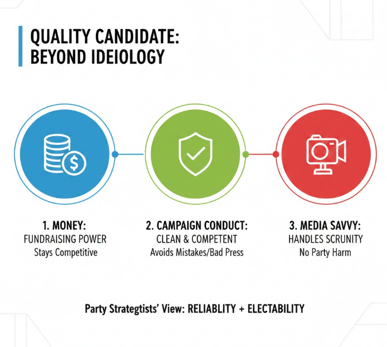
The data backs this up. Brookings research shows that in Senate races decided by close margins, candidates with statewide experience or proven fundraising strength usually perform better than first-time or outsider candidates, even in tough political environments. This does not mean outsiders can never win. It means the risk is higher. When control of the Senate is on the line, party leadership is less willing to take those risks and more focused on candidates who are steady, predictable, and hard to knock off course.
What This Means Going Forward
For candidates, the implications are unambiguous. Challenging a sitting Republican senator or a committee-backed recruit is no longer framed as healthy competition. It is treated as a threat to be neutralized. Those who attempt it should expect institutional resistance, not neutrality.
For donors, the strategy offers clarity. The NRSC is positioning itself as a gatekeeper of political capital. Resources will be concentrated on candidates deemed capable of winning, not on ideological statements or protest campaigns. The message is that discipline, not enthusiasm, is the currency of success.
This shift inevitably sidelines some grassroots energy. Activists who view primaries as accountability mechanisms will find fewer openings. But from the party’s perspective, that is the tradeoff. The priority is controlling outcomes, not facilitating debate.
Heading into 2026, the Republican Senate strategy is no longer ambiguous. The institution has chosen management over experimentation. Winning the chamber has become the organizing principle, even if it means limiting who gets to compete along the way.
Wrap Up
The NRSC’s effort to clamp down on incumbent hunting is a direct response to hard lessons learned over the past decade. Favorable maps mean little if the party nominates candidates who cannot close the deal. With Democrats defending more seats in 2026, Republicans see discipline as the difference between opportunity and failure.
Looking ahead, this strategy will shape not only who runs but how the party governs itself. If Republicans convert the favorable map into Senate gains, candidate quality will become an entrenched principle rather than a temporary tactic. If they fall short, pressure from the grassroots will intensify. Either way, the fight over primaries is already defining the 2026 Senate battlefield.