


In the places that decide control of Congress and the White House, term limits would scramble recruitment, reset incumbency, and force both parties to compete again.
What to Know
- Pivot counties represent the most volatile and decisive segments of the electorate
- Incumbency suppresses competition even in politically unstable regions
- Term limits would increase open-seat races and disrupt entrenched advantages
- Campaign strategy would shift toward earlier recruitment and localized messaging
- Momentum is building through both congressional proposals and state-level action
In the places that decide control of Congress and the White House, term limits would do more than rotate politicians. They would disrupt the current operating model, resetting recruitment pipelines, weakening incumbency advantages, and forcing both parties back into active competition. That shift is gaining traction, with Congress’s House Joint Resolution 12 and Senator Dave McCormick’s term limits proposal signaling renewed institutional focus on limiting tenure.

Pivot counties sit at the center of that disruption. These are not just swing regions but early indicators of coalition change, where margins remain thin and voter behavior is still in motion. Roughly 200 counties flipped from Obama to Trump, and they continue to function as pressure points in national elections . Control of power runs through these contested pockets, where structural changes can translate quickly into electoral outcomes.
The Incumbency Problem in Swing Terrain
Even in districts where voter behavior remains fluid, incumbents accumulate layered advantages that steadily narrow the field. Donor networks deepen, name recognition compounds, and media access stabilizes, gradually shifting races from open competition to controlled environments where the objective is to defend position rather than earn support. Party institutions often reinforce this dynamic.
As outlined in an analysis of the NRSC’s strategy, leadership is increasingly intervening early to discourage primary challengers, prioritizing “candidate quality” and general election viability over internal competition. This creates a structural disconnect. Pivot regions are defined by volatility, yet their representation often remains fixed.
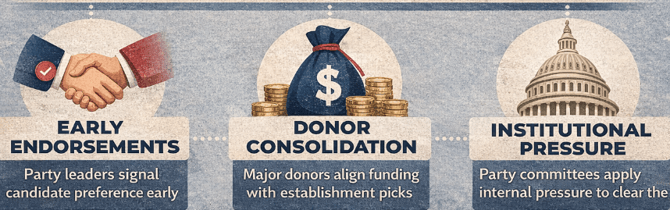
Credible challengers are not just deterred by cost or access barriers, but by a system that signals limited viability before campaigns even begin. Early endorsements, donor consolidation, and institutional pressure can effectively clear fields before voters engage. The system does not eliminate competition outright. It manages and constrains it. Voter movement continues beneath the surface, but candidate pipelines fail to scale with that movement, producing a bottleneck where electoral change outpaces the ability of new candidates to compete for representation.
What Term Limits Actually Change
Term limits do not determine outcomes. They change the operating environment. The precedent already exists. The 22nd Amendment, as outlined by the Reagan Library, limits presidential tenure to prevent the concentration of long-term power and ensure periodic turnover. Applied to Congress, the same principle would not guarantee better candidates but would force more consistent competition.
|
Why the 22nd Amendment Exists The 22nd Amendment was adopted after Franklin D. Roosevelt was elected to four terms, breaking the long-standing two-term precedent set by George Washington. Lawmakers moved to formalize limits to prevent any future president from holding power for too long. The amendment established a two-term cap to ensure regular leadership turnover and reduce the risk of concentrated executive authority. |

The most immediate effect is turnover. More open seats create entry points for new candidates and expand both primary and general election competition, reducing the role of accumulated incumbency advantages. Candidates would rely less on long-term name recognition and donor networks and more on their ability to build visibility and alignment quickly, pushing campaigns to start earlier and operate closer to district-level concerns.
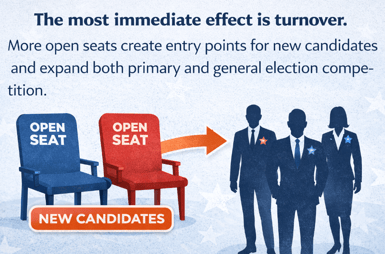
In pivot-heavy regions, where voter behavior is already shifting, that pressure becomes more consequential. Open-seat races require campaigns to engage directly with changing voter priorities rather than relying on established positioning. The result is a structural reset where competition increases and elections become more responsive to real-time voter movement.
The Campaign Strategy Reset
Advocacy for congressional term limits has become increasingly organized and institutionalized. U.S. Term Limits, a national nonprofit, is actively working to pass a constitutional amendment by coordinating efforts across Congress and state legislatures, while also mobilizing grassroots supporters and tracking which candidates and lawmakers commit to term limit pledges.

Their proposed framework calls for two six-year terms in the Senate and three two-year terms in the House, and their strategy relies on both federal action and state-driven pressure campaigns to advance the amendment.
Supporters argue that term limits would reduce entrenched political power and create a more responsive, citizen-driven legislature. This view aligns with arguments presented in Cato Institute analysis, which frames term limits as a mechanism to counterbalance structural advantages held by incumbents and political insiders. The analysis suggests that long-term tenure can reinforce existing power networks, making it more difficult for challengers to compete and for new voices to enter the system .
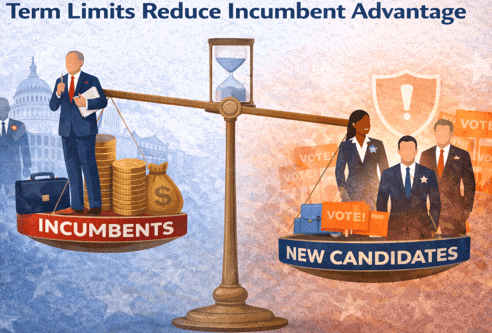
At the same time, the debate remains centered on trade-offs. While term limits may increase turnover and open-seat competition, they also shift experience levels within governing bodies and change how influence is accumulated. The current policy discussion reflects these competing considerations, with ongoing legislative proposals, advocacy campaigns, and institutional analysis shaping how term limits are evaluated as a structural reform.
Counterarguments: The Case Against Term Limits
A complete evaluation of term limits requires accounting for the institutional trade-offs. While limits may increase electoral competition, a range of policy analysts and legal scholars argue they can introduce constraints that reshape how Congress functions, often in ways that shift power rather than reduce it.
One of the most cited concerns is the loss of legislative expertise. Research from institutions like the University of Chicago’s Effective Government initiative notes that lawmakers develop policy depth, procedural fluency, and negotiating capacity over time. Removing experienced members on a fixed schedule can weaken committee leadership, reduce institutional memory, and make it more difficult to manage complex legislation, particularly in areas like budgeting, national security, and regulatory oversight.
A related critique focuses on the redistribution of influence. Analyses referenced by NPR and R Street highlight that when elected officials cycle out more frequently, long-tenured actors such as congressional staff, executive branch agencies, and lobbyists often fill the knowledge gap. These groups maintain continuity across administrations and election cycles, which can increase their relative influence in shaping policy, even as elected representation turns over more rapidly.
There is also concern regarding altered incentives as legislators approach the end of their tenure. This "lame duck" dynamic suggests that members who can no longer seek reelection may face reduced electoral accountability. Some research points to a shift in focus toward post-congressional career paths, such as roles in lobbying or the private sector, which can influence decision-making during their final terms.
|
What Is a “Lame Duck”? A “lame duck” is an elected official who is nearing the end of their term and cannot or will not run again. Because they no longer face voters, their decisions may carry less electoral accountability and can shift toward long-term positioning or post-office opportunities rather than immediate constituent pressure. |
Opponents argue that elections already provide a robust, built-in accountability mechanism. Voters possess the power to remove incumbents through regular elections, making term limits an external constraint on voter choice.
This argument is reinforced by the Supreme Court’s decision in U.S. Term Limits, Inc. v. Thornton, which held that states cannot impose term limits on federal lawmakers, emphasizing that qualifications for Congress are established at the national level and that electoral accountability remains the primary check.
Taken together, these arguments frame term limits not simply as a reform, but as a complex structural trade-off. While they may reduce incumbency advantages, they also reallocate expertise, influence, and accountability in ways that policymakers continue to debate.
Existing Proposals and Pathways
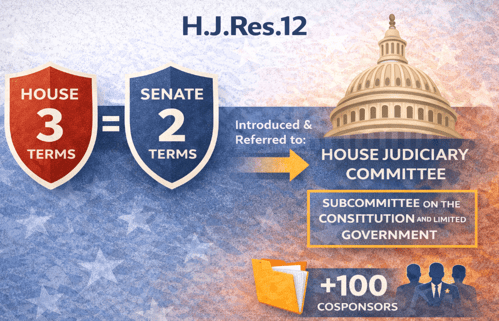
At the federal level, H.J.Res.12 is the primary legislative vehicle. It proposes limiting House members to three terms and Senators to two and has been introduced and referred to the House Judiciary Committee’s Subcommittee on the Constitution and Limited Government, with more than 100 cosponsors. The level and composition of support provide a signal of where momentum exists and whether the proposal is developing beyond a single-party effort.
At the state level, the Article V convention pathway is being actively pursued. This approach allows states to submit applications calling for a convention to propose constitutional amendments. U.S. Term Limits reports that multiple states have already passed such applications, with additional legislatures advancing similar resolutions, creating a parallel track that applies pressure outside of Congress.
The process remains difficult. An Article V convention has never been convened, and any amendment would still require ratification by three-fourths of the states. These thresholds highlight the procedural barriers, even as activity increases across both federal and state channels, indicating that term limits are being pursued as an active structural reform rather than a theoretical concept.
Wrap Up
Term limits are no longer theoretical. At the federal level, H.J.Res.12 proposes capping House members at three terms and Senators at two, with more than 100 cosponsors signaling sustained interest. At the state level, U.S. Term Limits reports multiple legislatures have already passed applications for an Article V convention, with others advancing similar efforts. While the amendment process remains difficult, activity across both tracks shows the issue has moved from abstract reform to active policy positioning.
Term limits function as a competitive reset. By reducing incumbency durability, they increase open-seat races and expand competition, particularly in pivot regions where small shifts can change outcomes. For campaigns, this shifts strategy toward earlier recruitment, stronger local positioning, and faster narrative control. The primary impact is structural, reopening races and accelerating how voter movement translates into electoral results.