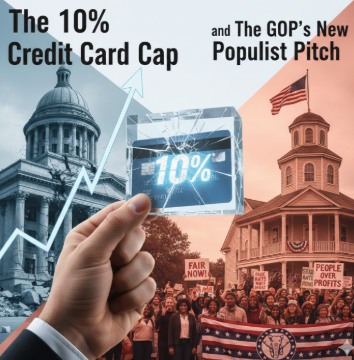

Trump's proposed 10% credit card interest rate cap is shifting the economic debate in Rust Belt counties, undercutting Democratic appeal to working-class voters.
What to Know
- Donald Trump has proposed a one-year federal cap limiting credit card interest rates to 10%.
- Republicans are deploying the policy as a clear affordability message in Rust Belt counties like Macomb County, Michigan.
- The proposal targets household debt anxiety rather than abstract economic indicators.
- The message breaks with traditional conservative opposition to market intervention.
- Democrats face growing pressure on economic ownership with working-class voters.
For years, Republican economic messaging in the Rust Belt leaned on tax cuts, deregulation, and growth narratives that often felt distant from daily financial stress. That approach is shifting. Trump’s proposal to cap credit card interest rates at 10% is emerging as one of the most potent populist messages of the 2026 cycle, particularly in working-class counties where household debt has become a defining economic reality.
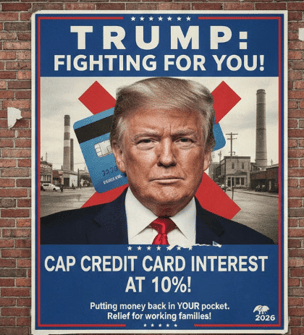
In places like Macomb County, Michigan, the issue is not whether the economy is technically growing. It is whether families can keep up with interest payments that quietly drain paychecks month after month. By focusing on credit card rates, Republicans are meeting voters where they are, not where economic theory says they should be.
The Policy Itself and Why It Matters
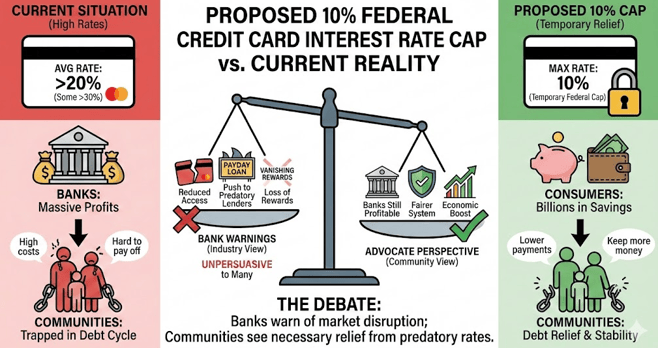
The proposal would impose a temporary federal cap on credit card interest rates at 10%, a dramatic reduction from current average rates that often exceed 20%. Banks have warned that such a cap would restrict credit availability and disrupt lending markets. Those arguments are familiar and, in many working-class communities, largely unpersuasive.
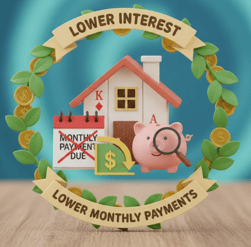
For voters carrying revolving balances, the policy is easy to understand. Lower interest means lower monthly payments and a clearer path out of debt. There is no spreadsheet required to grasp the benefit. That simplicity is part of the strategy.
According to reporting by PBS NewsHour, the banking industry has pushed back aggressively, framing the cap as government overreach. Politically, that opposition may only strengthen the message. Republicans are positioning themselves against banks rather than alongside them, a notable reversal from past cycles.
Affordability as the Core Frame
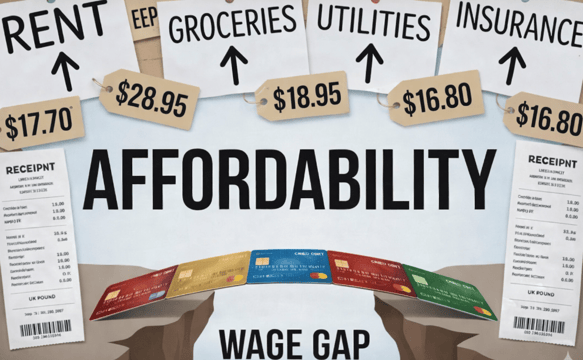
Affordability has become the dominant economic concern for many voters, especially in industrial and post-industrial regions. Rent, groceries, utilities, and insurance have all risen faster than wages. Credit card debt often fills the gap.
By focusing on interest rates, Republicans are not promising abstract prosperity. They are promising relief. That distinction matters. Voters who feel squeezed are more responsive to policies that address expenses rather than income projections.
Where many households rely on credit cards to manage irregular expenses, the cap functions as a pocketbook issue with immediate relevance. Republican candidates are framing it as protection against predatory lending rather than regulation for its own sake. This framing also avoids culture war distractions. It keeps the conversation grounded in household math, an area where frustration runs deep and partisan loyalty is weaker.
Why Rust Belt Voters Are Responding
Rust Belt voters have long been labeled “economically anxious,” but that shorthand no longer captures the reality shaping their political behavior. The anxiety today is less about unemployment and more about financial precarity. Many voters are working, sometimes multiple jobs, yet still feel exposed. A single car repair, medical bill, or spike in grocery prices can push a household from stability into crisis. Employment no longer guarantees security, and voters know it.
The proposed credit card interest rate cap speaks directly to that sense of fragility. Rather than framing debt as a moral failure or a budgeting problem, it implicitly acknowledges that many families are carrying balances because the cost of living has risen faster than wages. Rent, insurance, utilities, and food costs have all climbed, while real wage growth has lagged. For voters living that reality, the acknowledgment itself matters. It signals recognition rather than judgment.
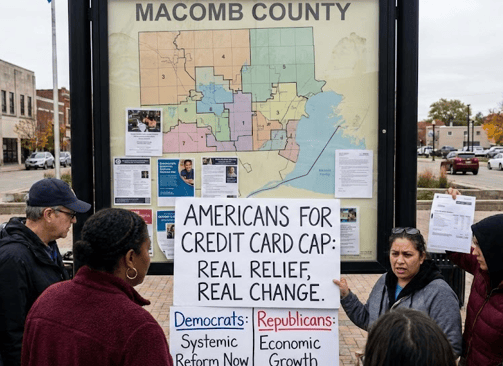
In pivot counties like Macomb County, Michigan, where electoral outcomes have swung between parties over the past decade, this message resonates precisely because it mirrors lived experience. These voters have heard Democrats emphasize systemic reform and Republicans emphasize economic growth. Both messages can feel distant. The credit card cap offers something more tangible. It addresses a pain point that voters encounter every month when statements arrive and minimum payments barely dent principal balances.
The policy also fits neatly into Trump’s broader populist narrative. Framed as a move against powerful financial institutions, it reinforces the idea that the political fight is between ordinary people and entrenched interests. That framing has proven durable in the region, even when voters are skeptical of Washington as a whole. For many Rust Belt voters, the appeal is not ideological consistency but perceived alignment with their day-to-day struggles.
Populism Versus Traditional Conservative Economics
The proposal represents a sharp departure from traditional conservative economic doctrine. Interest rate caps have long been criticized within Republican policy circles as market distortions that limit credit availability, reduce lender participation, and produce unintended consequences. Those arguments remain influential among economists and think tanks, but they carry far less weight with voters who believe the market has already failed them.
For these voters, high interest rates are not an abstract policy debate. They are a recurring penalty for falling behind in an economy that feels structurally tilted against them. The GOP’s willingness to sidestep ideological purity reflects a strategic calculation rather than a philosophical conversion. Holding or expanding support among working-class voters now outweighs adherence to supply-side orthodoxy.
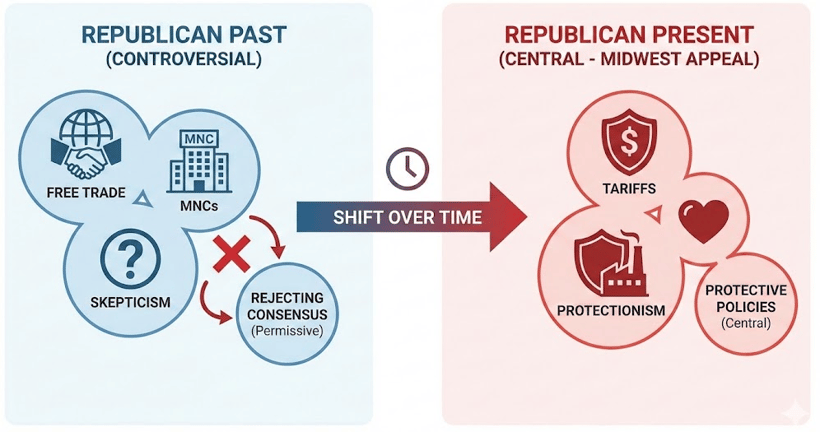
This shift mirrors earlier populist pivots within the party. Tariffs, skepticism toward free trade, and hostility toward multinational corporations were once controversial within Republican ranks. Over time, they became central to the party’s appeal in the Midwest. Each move involved rejecting consensus economic thinking in favor of policies that felt protective rather than permissive.
The result is a Republican economic message that increasingly resembles consumer protection, at least rhetorically. While the long-term policy implications remain contested, the short-term political value is clear. The party is signaling that it is willing to intervene when markets appear to exploit rather than serve ordinary Americans.
The Challenge for Democrats
Democrats have traditionally owned economic fairness messaging, especially on issues involving corporate power. The credit card cap complicates that advantage. If Republicans are seen as the party willing to directly curb financial institutions, Democrats risk losing credibility with voters who prioritize immediate relief over long-term reform. Progressive critiques of the cap as insufficient or temporary may ring hollow to families focused on next month’s bill.
This does not mean Democrats lack counterarguments. Concerns about unintended consequences and access to credit are valid. The challenge is translating those concerns into messages that feel relevant rather than abstract. Failure to do so could leave Democrats defending banks by default, an uncomfortable position in working-class districts.
Wrap Up
The 10% credit card interest cap is more than a policy proposal. It is a signal that Republicans are recalibrating their economic message around affordability and financial stress. In Rust Belt counties like Macomb, that recalibration is finding traction because it addresses a problem voters feel every month.
Looking ahead to 2026, the broader implication is clear. Economic ownership is no longer fixed. Parties that adapt their messaging to lived experience, even at the expense of ideological consistency, gain an edge. For voters, the debate will hinge less on theory and more on whether either party can offer tangible relief in an economy where debt has become a defining feature of daily life.