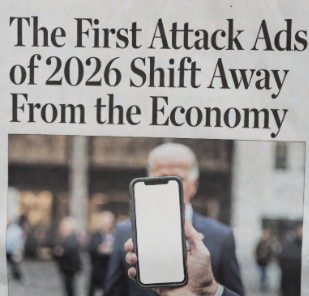

The first 2026 midterm ads signal a major strategic shift: campaigns are aggressively focusing on cultural issues early, moving away from traditional economic arguments.
What to Know
- The first negative ads of 2026 center on culture war issues, not the economy.
- Abortion, transgender issues, and classroom curriculum fights dominate early messaging, framed as a defense of “values.”
- This marks a shift from prior midterms, where inflation and jobs drove initial attack ads.
- Tracking from the Wesleyan Media Project shows a clear spike in early-cycle ads mentioning social issues compared to previous cycles.
- The strategy is designed to energize partisan bases through emotional, identity-driven appeals.
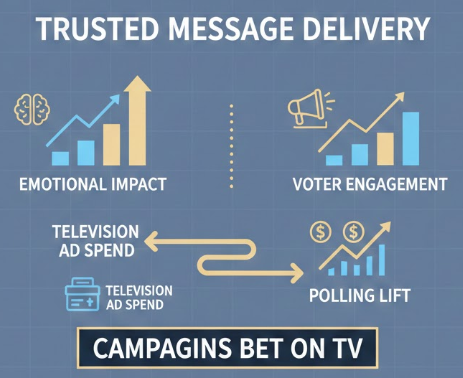
The 2026 campaign is opening with a fight over cultural direction rather than cost of living charts. The first wave of negative advertising is not centered on inflation or wages, but on life protections, parental authority in classrooms, and the defense of women’s sports and biological standards. As Ad Age reports in its analysis of political advertising strategy, campaigns are placing significant bets on television to deliver emotionally charged messages in environments voters still trust. The early ad war suggests strategists believe values driven appeals will mobilize voters more effectively than debates over mixed economic data.
At the same time, the broader media ecosystem is shifting. Research from the Democracy Project highlights the expanding role of political influencers in shaping how Americans consume and interpret civic information, often outside traditional regulatory structures. That convergence between trusted television and loosely governed digital personalities signals a 2026 cycle built on intensity and identity.
Who Fired the Opening Shots?
The first shots were fired in key battleground states. In North Carolina's Senate race, the GOP immediately countered Democratic Governor Roy Cooper's campaign announcement in July 2025 with an ad simply branding him a "wreck."

Governor Roy Cooper, image via official website
By August, major Republican super PACs like the Senate Leadership Fund revived a contentious line of attack from the previous cycle, airing television ads in Georgia and North Carolina that targeted Democrats, including Senator Jon Ossoff, over their support for transgender rights. One such ad, aired during a basketball game, accused Ossoff of not being "woke enough" and playing for "they/them."

Senator Jon Ossoff, image via Wikicommons
Party committees also entered the fray early. The National Republican Congressional Committee (NRCC) launched a digital ad campaign in November 2025 targeting Democratic-held seats in Iowa, accusing the party of pushing a "radical agenda" to "defund the police, abolish ICE and replace common sense with chaos."
As the calendar turned to 2026, the spending and intensity escalated dramatically, particularly in primary contests. In Texas, dueling super PACs spent heavily to influence both the Democratic and Republican Senate primaries, with ads attacking candidates like Rep. Jasmine Crockett and Rep. Wesley Hunt.
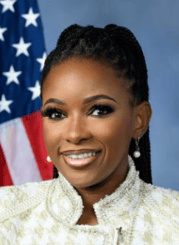

Rep. Jasmine Crockett and Rep. Wesley Hunt.
Reports indicate that the National Republican Senatorial Committee quietly attempted to shape the Democratic field by signaling that Crockett would be their preferred general election opponent. According to multiple accounts, the NRSC circulated internal polling portraying her as the strongest Democratic primary contender, a move widely interpreted as an effort to boost her standing and encourage her candidacy.
Politico and The New Republic documented this behind-the-scenes strategy, noting that Republican operatives circulated favorable polls and amplified those results to create a narrative of Crockett’s momentum in the primary. This flood of early negative advertising, months before many voters typically tune in, signals a new era of perpetual campaigning. It underscores a strategy to define opponents and frame the political narrative on their own terms long before the general election season officially kicks off.
Culture Before Cost of Living: A Deeper Look Into California
A clear example of this early cultural positioning is a recent gubernatorial ad in California from Democratic candidate Stephen Cloobeck. Rather than leading with housing costs, tax policy, or economic performance, the spot centers on character and values, directly targeting Donald Trump and invoking broader cultural anxieties.
First ad of California governor's race takes aim at Trump | FOX 11 LA
Stephen Cloobeck 2026 campaign ad. Source: YouTube.
The ad leans heavily on emotional contrast and symbolic framing, reinforcing the pattern emerging across early 2026 messaging. It illustrates how campaigns are prioritizing identity-driven narratives and moral positioning over detailed economic argumentation. Even in a state where affordability dominates voter concern, the opening salvos are being fought on terrain designed to provoke reaction rather than debate.
Why Culture War Messaging Works on Television
Historically, this is not a new development. Cultural and identity-based appeals have long been central to negative political advertising, particularly when campaigns seek to trigger emotional responses rather than policy debate. Economic arguments often require context, statistics, and explanation. Cultural flashpoints do not. They rely on symbolism, imagery, and perceived threats to values, which translate quickly in short-form advertising.
A 2020 segment from WTHR, the NBC affiliate in Indianapolis, examined the long tradition of negative political ads and how campaigns have consistently used emotionally charged messaging to define opponents early. The report highlighted how attack ads frequently emphasize character, values, and fear over detailed policy disputes. That pattern is visible again in the opening phase of the 2026 cycle, where cultural contrasts are being deployed before economic debates fully take shape.
WTHR report examining the long history and strategic use of negative political advertising. Source: WTHR, YouTube.
The difference now is not the existence of negative advertising. It is the speed, scale, and media environment in which it operates. There is also a visual component. Culture-based messaging lends itself to emotionally charged imagery: classrooms, athletic competitions, public safety footage, religious settings. These scenes translate effectively to broadcast formats, especially 30-second spots that can build narrative tension. Economic messaging, by contrast, often relies on abstract data or testimonial storytelling that feels less urgent in the early phase of a cycle.
The early 2026 strategy suggests campaigns are pairing the most polarizing themes with the most trusted medium. That is not accidental. It reflects a calculation that persuasion begins with emotional alignment, not spreadsheet literacy.
Broadcast vs Digital Negativity
The first wave of 2026 attack ads is not limited to traditional television. Campaigns are deploying a coordinated multi-platform strategy, with early spending tilted heavily toward digital. Barrett Media reports that the initial cycle data shows digital capturing roughly 34% of early ad spending, compared to 22% for Connected TV, 21% for cable, and 19% for traditional broadcast. That distribution reflects where voters are actually seeing ads.
In 2024, Business Wire said that 59% of voters reported encountering political ads on digital platforms, compared to 41% on television, with younger voters far more likely to see ads online.
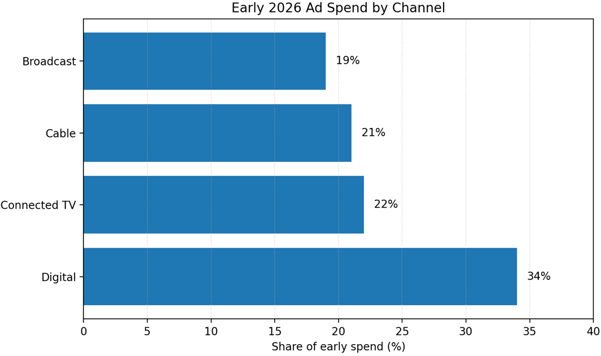
Image made by Gemini, data from Barrett Media
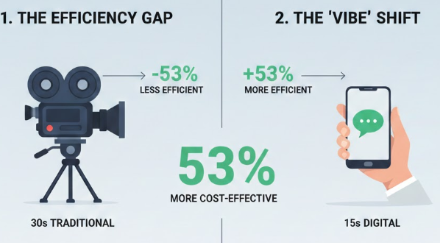
The format and tone shift depending on the screen. Fifteen-second digital spots have proven highly efficient, with one study from Blueprint finding them 53% more cost-effective on a per-second basis than traditional 30-second ads. Social platforms also favor informal, “selfie-style” videos that feel conversational rather than cinematic.
Regulatory differences further widen the gap. Broadcast ads require a verbal “stand by your ad” approval, while online ads only need a visible disclaimer for four seconds, and in smaller formats can rely on a simple icon or link. The result is a two-track negativity strategy: high-trust television for broad credibility, and faster, less constrained digital channels for sharper, more targeted attacks.
The Data Confirms the Narrative
This early emphasis on cultural contrasts is reinforced by broader advertising research about where persuasion actually works. According to the Ad Age analysis of new survey data, 61% of voters say they trust political ads on television, compared to just 39% who trust political ads on social media. In a cycle defined by emotionally charged messaging, campaigns are not only choosing sharper themes, they are choosing to deliver them on platforms voters consider credible. When trust drives attention, attention drives recall.
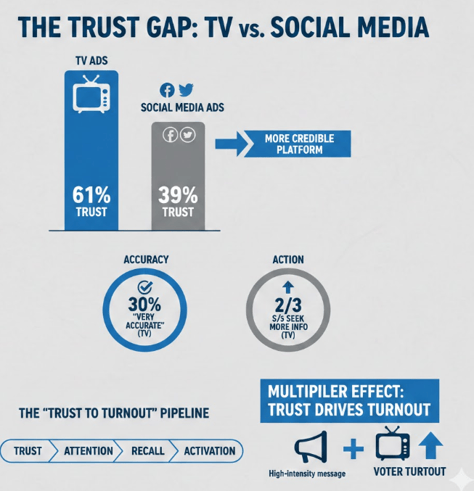
Image made by Gemini, Data from Ad Age
The same research shows that 30% of respondents rate political ads on TV as “very accurate,” the highest score among media formats, and roughly two-thirds say they seek more information after seeing political ads. That engagement matters. Campaigns understand that mobilization begins with trust and reinforcement, not just exposure. In a fragmented media environment, pairing high intensity messaging with a high trust medium creates a multiplier effect.
The Economic Silence
The decision to sideline the economy is not accidental. While headline indicators show resilience, voter perception remains unsettled. According to the same Ad Age–cited survey, 72% of voters rate the economy as “fair” or “poor,” underscoring the gap between macroeconomic data and lived experience.
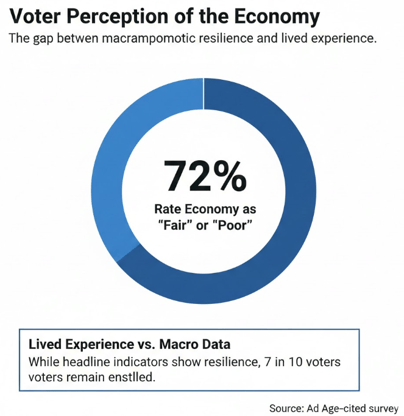
Image made by Gemini, Data from Ad Age
That disconnect creates strategic risk for both parties. Incumbents cannot simply point to GDP growth or low unemployment when household budgets still feel tight, and challengers struggle to argue economic collapse when labor markets remain historically strong. This ambiguity makes economic messaging harder to weaponize early in the cycle. By contrast, cultural and social flashpoints provide clearer lines of contrast and stronger emotional activation.
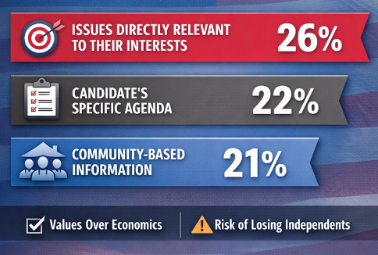
Image made by Gemini, Data from Ad Age
Research also shows that voters respond most to content that feels directly relevant to their interests at 26%, followed by a candidate’s specific agenda at 22%, and community-based information at 21%. Campaigns appear to be interpreting that data through a values lens, prioritizing issues that generate immediate intensity and clarity rather than nuanced fiscal debates. The strategic gamble is that mobilizing conviction outweighs persuading uncertainty, even if that approach risks narrowing appeal among financially focused independents.
Wrap Up
The 2026 ad wars have started with a roar, but the sound is not the familiar din of economic debate. It is the thunder of a culture war being waged for the heart and soul of the country. By launching their opening attacks on the terrain of values and identity, campaigns are setting the tone for a midterm cycle that will be defined by its deep divisions and emotional intensity. This strategy is a high-stakes gamble that a fired-up base is the surest path to victory, even if it comes at the cost of further alienating a weary and divided electorate.
Looking forward, this early tactical shift could have lasting consequences for American political discourse. An election cycle fought primarily on the battlefield of the culture wars risks deepening the chasm between red and blue America, making compromise and consensus-building even more difficult. It forces citizens into partisan trenches, where identity trumps policy and a candidate's stance on social issues becomes the sole litmus test for their fitness for office.
The long-term health of the republic may depend on whether campaigns can be persuaded to return to a debate about how to govern, or whether the allure of winning by dividing is simply too powerful to resist.