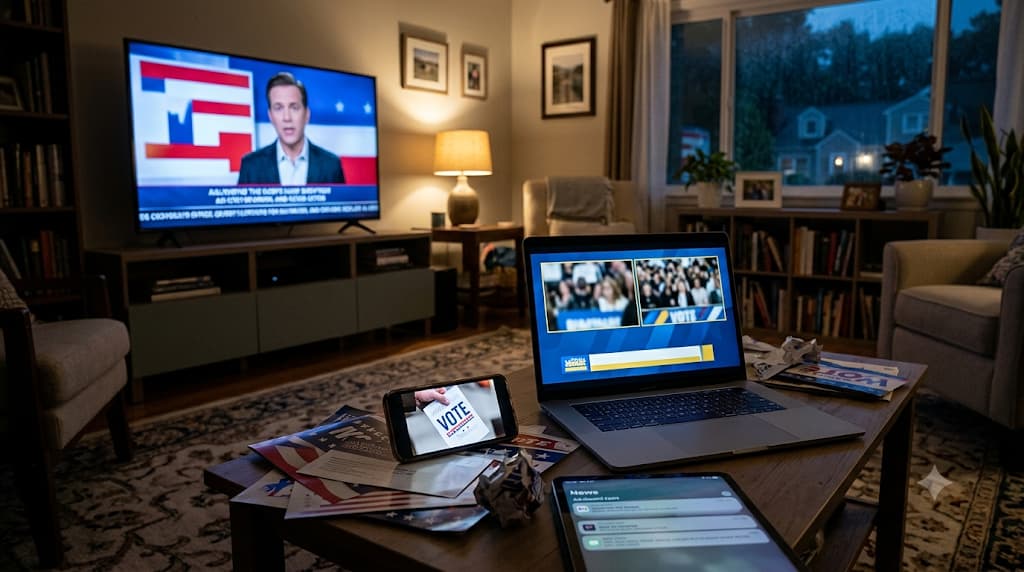

Record spending cannot rescue campaigns when repetitive ads exhaust voters, waste impressions and replace locally relevant persuasion with noise.
What to Know
- One-third of voters say excessive political advertising makes them less favorable toward the campaign responsible for the repetition.
- Political ad awareness is fragmented across social media at 54%, local news at 39% and streaming television at 35%.
- Nearly 80% of voters want political messages to feel relevant to the communities where they live and cast ballots.
- More than 60% prioritize receiving the right message over encountering a campaign on the right platform or more frequently.
- Political advertising is projected to reach a record $11.6 billion during the 2025–2026 election cycle.
Political campaigns are entering a record-spending cycle with a serious attention problem. Voters move among television, streaming, social platforms, news sites and mobile devices. Campaigns risk mistaking repeated delivery for expanded reach and spending millions making the same households tired of them.
The warning comes from Digital Remedy, which surveyed 1,000 U.S. voters in April 2026. Its findings show that political ad fatigue is more than a familiar campaign-season complaint. Overexposure can reduce favorability, fragmented viewing can conceal duplication and locally irrelevant creative can weaken every additional placement.
Overexposure Is Becoming a Persuasion Problem
Political ad fatigue is becoming a measurable persuasion risk rather than a temporary irritation. Repetition may initially strengthen recognition, but excessive exposure can change how voters feel about the campaign delivering the message. That shift makes frequency management an important part of both media planning and creative strategy.
Digital Remedy found that one-third of voters become less favorable toward a campaign after seeing too many of its ads. That changes the meaning of frequency because the downside is not limited to annoyance. A media plan intended to reinforce a candidate can produce the opposite association when exposure continues without control.
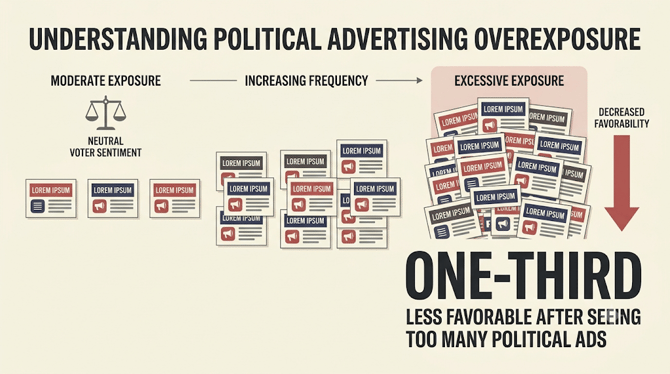
Campaign Now (Gemini), excessive exposure can reduce campaign favorability.
Campaigns rarely manage the full volume surrounding a voter. Candidate committees, parties and outside groups may deliver similar arguments through different vendors, with each organization reporting performance separately. A campaign may consider its frequency reasonable while the household experiences constant repetition.
This reporting structure creates a blind spot. A connected television vendor may show strong completion rates, a social platform may report inexpensive impressions and a local publisher may document high visibility. Every result can be accurate while the combined plan continues serving the same households and misses other persuadable voters.
A sponsored Campaigns & Elections case study published in May 2026 offers another warning. Analysts reviewed dozens of campaigns before testing frequency groups during the 2025 New Jersey gubernatorial race. Voters in the optimal-frequency group showed stronger persuasion and decisiveness, while higher exposure added impressions without proportional gains.
The study does not establish one universal frequency cap. It shows that useful levels vary according to the audience, creative, partisanship and competitive environment, making continuous testing more valuable than a fixed rule. Frequency should be an adjustable input connected to persuasion rather than a scoreboard that automatically improves as the number rises.
Fragmentation Makes Duplicate Reach Harder to See
Political audiences are no longer concentrated on one screen or platform. Voters may encounter the same candidate through social media, local journalism, connected television, broadcast television and mobile video within a single day. Measuring each channel independently can therefore conceal how often the same households are being reached.
The Digital Remedy survey found political ad awareness across social media at 54%, local news at 39% and streaming television at 35%. These are overlapping places where respondents noticed political messaging, not exclusive shares that can be added together. Their significance is that no platform controls political attention, making separate channel reports insufficient for understanding total household exposure.
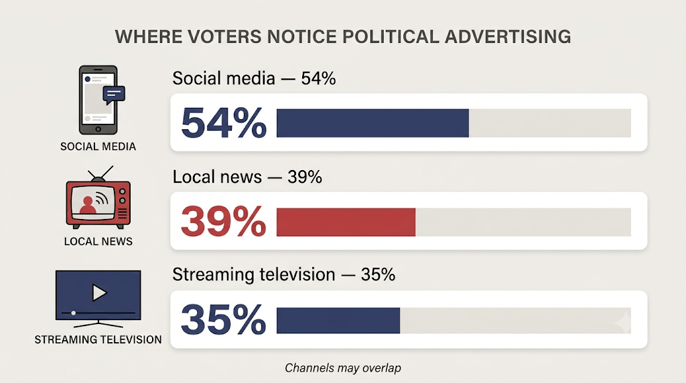
Campaign Now (Gemini), voter attention is fragmented across platforms.
The television market is fragmented as well. A Cross Screen Media report published in April 2026 says linear television has continued losing viewership to streaming since the previous midterm cycle. It focuses on where persuadable voters can be reached because consumption differs across states, districts and competitive races.
That uneven consumption makes old buying assumptions less dependable. A schedule performing well across an entire designated market area may still underdeliver inside the district deciding the election. Impressive market-wide totals may also be driven by overserving households outside the campaign’s most important geography.
Fragmentation does not mean campaigns should abandon broadcast television or declare streaming the only future. AdImpact projects that broadcast television will receive 48% of cycle spending, equal to $5.6 billion, while connected television will receive 23%, or $2.7 billion. Digital spending across Facebook, Google, Snapchat and X is projected at $1.6 billion, creating a mix where duplication is easy and unified measurement becomes valuable.
Voters Want Relevance Instead of Repetition
More exposure does not correct a message that feels generic or disconnected from the voter receiving it. Political advertising becomes more useful when the argument reflects the places, pressures and priorities shaping a specific electorate. Local relevance can therefore improve performance without requiring campaigns to increase frequency.
Nearly 80% of voters in the Digital Remedy survey said political messaging should feel relevant to their local community. That challenges national creative copied into every district with only a candidate name, office or location changed. Voters experience national debates through local housing costs, employers, schools, infrastructure, public safety and services.
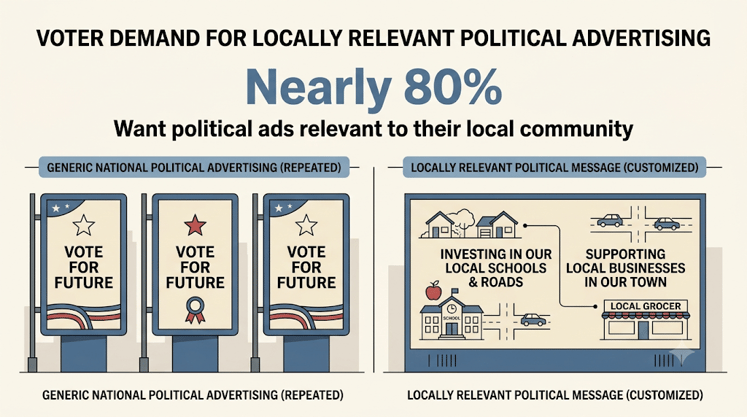
Campaign Now (Gemini), voters prefer locally relevant political messaging.
More than 60% also said campaigns should prioritize the right message over appearing on the right platform or appearing more frequently. Platform selection still matters because a persuasive message has no effect when the intended audience never receives it. The finding shows that delivery cannot compensate for creative that feels generic, mistimed or disconnected from local experience.
Local relevance requires more than inserting a town name into an advertisement. The evidence, examples, language and visual setting should reflect the district and the voters the campaign needs to move. A housing message may require different proof in a growing suburb, an expensive urban district and a rural county with limited construction.
That distinction matters most when several campaigns compete for the same persuadable audience. A locally grounded advertisement can separate one candidate from a flood of interchangeable national messages without increasing exposure. Better creative therefore improves the value of existing reach, while another generic placement may simply deepen fatigue among voters who already understand the campaign’s argument.
Record Spending Raises the Cost of Waste
The scale of the coming election cycle increases the financial consequences of weak targeting and uncontrolled repetition. Large budgets can produce impressive delivery totals while hiding how much spending reaches households that have already received the message. Waste becomes harder to recognize when impressions continue rising and every platform presents its own performance report.
AdImpact projects that political advertising during the 2025–2026 cycle will reach a record $11.6 billion. That would exceed the $11.2 billion spent during the previous presidential cycle and the $8.9 billion midterm record set in 2022. Record spending increases the cost of mistakes because inefficient repetition can absorb substantial money before a campaign recognizes the problem.
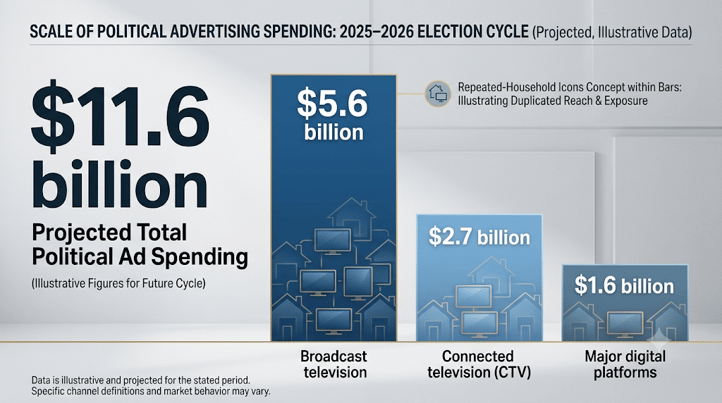
Campaign Now (Gemini), record spending increases the cost of repetition.
Broadcast television remains the largest projected category, but connected television continues growing rapidly. The expanding mix gives campaigns more opportunities to reach voters who are difficult to find through one channel. It also creates more opportunities for separate buyers to purchase exposure unknowingly against the same households.
The pressure is especially intense in competitive congressional races. AdImpact lowered its House projection from $2.2 billion to $2 billion after redistricting made 28 races less competitive. More spending may therefore be concentrated in fewer battlegrounds, increasing the likelihood that persuadable voters there will receive heavy advertising from several organizations.
Large budgets can conceal inefficient strategy because impressions remain easy to purchase and report. Incremental reach, creative relevance and movement among undecided voters are harder to measure across platforms. When reporting favors the easiest metric, teams can celebrate delivery even while paying repeatedly for people already reached.
Better Measurement Starts With Incremental Reach
Campaign measurement becomes more useful when it shows which households have been reached, how often they have received the message and where duplication is occurring. That approach moves the conversation away from raw delivery totals and toward the additional voters produced by each media purchase. It also gives campaigns a clearer view of where money can be redirected before fatigue becomes a larger problem.
Digital Remedy introduced VoterReach to connect household delivery with the geography determining election outcomes. The tool maps campaign data across congressional districts, state legislative districts, ZIP codes, counties and designated market areas. It reports unique households, average frequency, device distribution, publisher overlap, cost per unique household and high-exposure areas where money could be reallocated.
That approach changes the main planning question. Instead of asking which platform produced the most impressions, a campaign can ask which purchase added households not already reached elsewhere. A smaller placement may be more valuable when its audience is genuinely incremental.
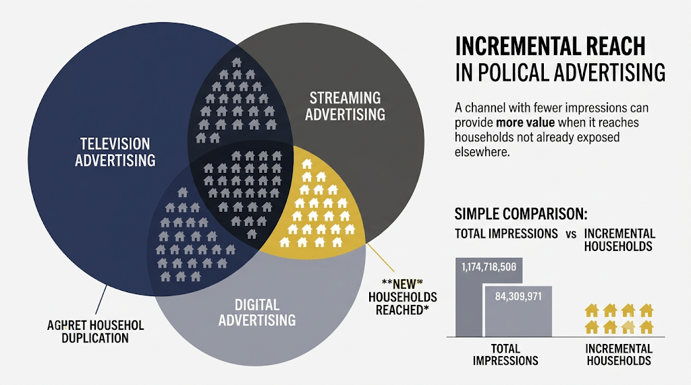
Campaign Now (Gemini), incremental reach reveals which households are new.
District-level measurement also exposes geographic waste. A campaign can identify whether strong overall delivery is being driven by safe areas while competitive precincts remain underserved. It can also locate places where repeated exposure consumes money without adding meaningful voter contact.
A Campaigns & Elections briefing published in July 2026 described this emerging discipline as reliable reach. Media buyers from both parties emphasized following audiences to channels that consistently deliver them rather than purchasing every available screen. The shared principle is selectivity rather than loyalty to either traditional or digital media.
Measurement alone cannot determine whether a message is credible or persuasive. Household overlap can reveal duplication, but it cannot decide whether an argument fits local priorities or earns voter attention. Strong plans combine cross-channel visibility with message testing, geographic knowledge and evidence showing whether voters become more favorable or decisive.
Wrap Up
Political advertising is not entering a low-spending era. It is entering a record cycle where limited attention collides with fragmented consumption, overlapping buyers and resistance to overexposure. Another impression becomes less valuable when it reaches a household that has already received the same argument repeatedly.
The verified findings point in one direction. One-third of voters report becoming less favorable after excessive exposure, nearly 80% want local relevance and more than 60% place the right message ahead of platform or repetition. Frequency testing and spending projections reinforce the lesson that volume and persuasion are different outcomes.
The flop era begins when campaigns celebrate dashboard growth while voters experience noise. Better performance comes from controlling repetition, expanding incremental reach and connecting creative to the communities receiving it. In 2026, campaigns that respect voter attention as finite will have an advantage over those treating it as an unlimited impression pool.