
A new constitutional amendment heads to voters as polling and organizing point to potential turnout effects.
What to Know:
- The Wisconsin State Senate has passed Assembly Joint Resolution 10, sending a religious freedom constitutional amendment to voters in November
- The amendment would prohibit state and local governments from forcing churches to close during declared emergencies
- New polling from Badger Battleground shows 55% of likely voters support the amendment, while 31 percent oppose it, with opinion divided mainly in the Madison media market
- Wisconsin Family Action is preparing a statewide turnout operation tied to the referendum, targeting voters who often skip midterm elections
- In recent elections, church based outreach has successfully mobilized tens of thousands of low propensity conservative voters in Wisconsin
The Wisconsin State Senate has passed Assembly Joint Resolution 10, clearing the final legislative requirement needed to place a religious freedom constitutional amendment before voters this fall. The resolution would prohibit state and local governments from forcing churches and places of worship to close during declared states of emergency. Passage in the Senate completes approval in a second consecutive legislative session, automatically triggering a statewide referendum in November under Wisconsin’s constitutional process.
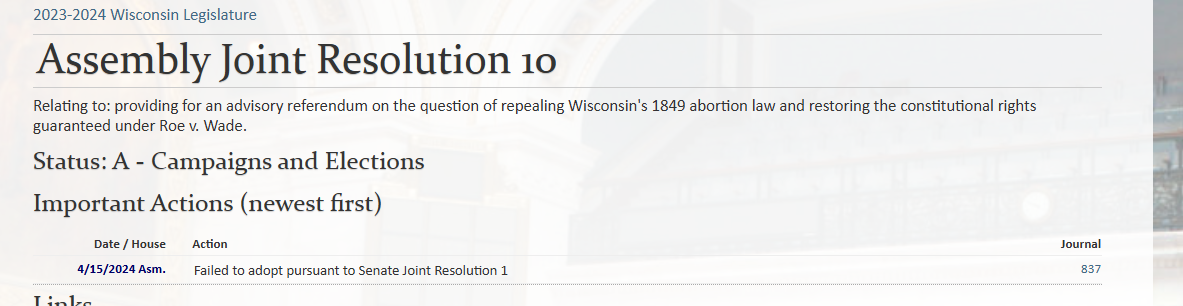
Screenshot from website
Recent polling suggests the proposed amendment enters the 2026 cycle with a structurally favorable electorate. A statewide survey of likely general election voters commissioned by Wisconsin Family Action found 55% support for the constitutional amendment, compared with 31% opposition, with the remaining respondents undecided. The poll surveyed 500 likely voters and carries a margin of error of ±4.4%. The results were published by WisPolitics in a January 2026 memorandum summarizing the findings of Platform Communications’ Badger Battleground Poll, fielded April 7–9, 2025.
Public Support and COVID-Era Origins of the Amendment
Polling shows the amendment begins with a favorable electorate, with support broadly consistent across race and gender and holding across most regions of Wisconsin. The Madison media market is the primary exception, where opinion is more closely divided. Conservative voters express the strongest backing, with more than seven in ten in support, while non-white voters also favor the measure by a clear margin. Left-leaning voters are more evenly split, suggesting resistance is driven more by geography than partisanship alone.

The proposed amendment traces directly to disputes during the COVID era, when emergency public health orders led to the closure of churches across the state and were later challenged in court. Following legislative passage of Assembly Joint Resolution 10, Daniel Degner, president of WFA, framed the effort as a response to those actions, stating,
“In 2020, we saw the government use emergency powers to abridge the people’s right to assemble in places of worship.”
Wisconsin Family Action has publicly outlined plans to work through established church networks to educate and mobilize voters ahead of the 2026 election, integrating the referendum into a broader, congregation-based turnout strategy rather than treating it as a standalone ballot fight.
From Pandemic Dispute to Ballot Question
The amendment’s path to the ballot reflects how pandemic era governance debates have hardened into durable political issues. In 2020, emergency public health orders led to widespread church closures across Wisconsin. Those orders were later challenged, culminating in a Wisconsin Supreme Court ruling that certain executive actions exceeded constitutional limits and restored in person worship.
Wisconsin Supreme Court image from website
Rather than fading as a one time crisis, the dispute reshaped how many voters evaluate emergency authority, constitutional rights, and executive power. The decision by lawmakers to place explicit language into the state constitution signals that those questions remain unsettled for a significant share of the electorate. The polling indicates that voters continue to view the issue through a rights based lens rather than as a technical public health question.
Polling Shows Broad Support With Clear Geographic Fault Lines
Polling released by Wisconsin Family Action as part of the Badger Battleground Poll shows that support for the amendment is not confined to a narrow ideological group. Conservative voters support the measure at 71%. Non-white voters also register majority support at 62%. Support remains near 60% across most regions of the state.
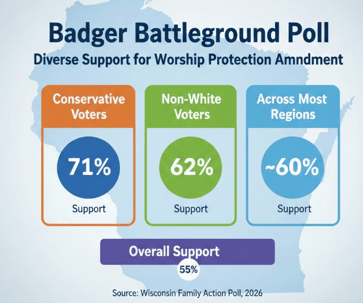
The Madison media market is the notable exception. There, opinion is closely divided, reflecting the area’s more progressive political profile. This geographic split mirrors recent statewide election patterns in which Madison and Milwaukee provide Democratic margins that are offset by strong Republican performance elsewhere.
Because constitutional amendments require statewide approval rather than district level wins, these regional dynamics matter less for passage than they do for turnout effects in legislative and congressional races running alongside the referendum.
Organizational Turnout Plans Are Already Public
Unlike many ballot measures that emerge late or operate without clear sponsorship, this amendment is being paired with an explicit turnout strategy.
In communications to county Republican leaders, Wisconsin Family Action outlined its recent turnout record and future plans. During the 2025 spring election, the organization targeted two hundred seven thousand Christian conservative voters who participated in the 2024 election but typically skip spring contests. According to the organization, 129,000 of those voters turned out, aided by outreach through more than one thousand churches statewide.
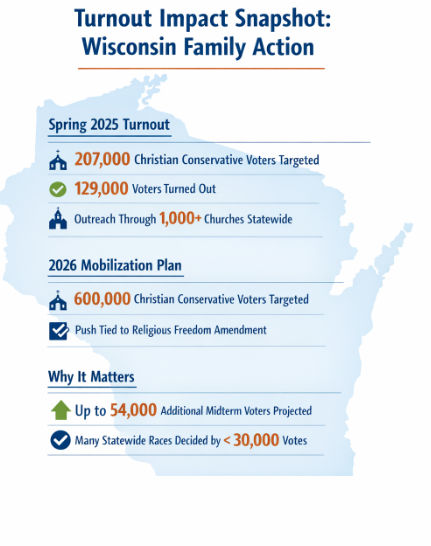
For 2026, Wisconsin Family Action has publicly stated its goal of engaging 600,000 Christian conservative voters in support of the amendment and aligned candidates. The organization estimates that full funding of its program could mobilize an additional fifty four thousand voters who normally sit out midterm elections. In a state where many statewide races are decided by margins smaller than thirty thousand votes, those numbers are strategically meaningful.
Ballot Measures, Turnout, and Strategic Risk
Ballot initiatives have repeatedly shown an ability to reshape turnout, though not always in durable ways. On the left, abortion referenda in states such as Michigan and Ohio coincided with measurable increases in participation among younger voters and women, helping Democrats in key statewide and down-ballot races. Marijuana legalization measures in states like Colorado and Arizona produced similar effects, temporarily expanding the electorate in favorable ways. In most cases, however, post-election analyses found that these gains were strongest in the cycle in which the measure appeared and tended to fade once the policy question was resolved.
What distinguishes the Wisconsin religious freedom amendment is its integration into an established, church-centered mobilization network rather than reliance on issue novelty. Public information from WFA highlights longstanding ties to congregations across the state, including voter education, church-level engagement, and coordination with aligned grassroots and party organizations. That infrastructure mirrors conservative faith-based campaigns in other states, where ballot measures function less as one-time turnout spikes and more as participation anchors, increasing the likelihood that mobilization effects extend beyond the referendum itself into surrounding legislative and congressional races.
Wrap Up
The religious freedom amendment heading to Wisconsin voters this fall is not simply a retrospective debate about pandemic policy. It is a forward looking test of whether values based ballot measures can still reshape midterm electorates in narrowly divided states.
Polling shows majority support statewide. Organizational plans indicate an aggressive turnout operation aimed at voters who reliably participate in presidential elections but often skip midterms. In Wisconsin, where control frequently hinges on margins smaller than the projected turnout increase, the amendment has the potential to influence not only its own passage but the broader political landscape surrounding it.
For campaigns watching Wisconsin, the lesson is less about the specific policy language and more about the mechanism. When ballot measures intersect with identity, constitutional framing, and existing grassroots infrastructure, they can change who shows up. In close elections, that shift can matter more than persuasion ever could.